Showing posts with label philosophy. Show all posts

Saturday, March 2, 2013

Surfing the Sierras - Sierra Safari - Final Cut

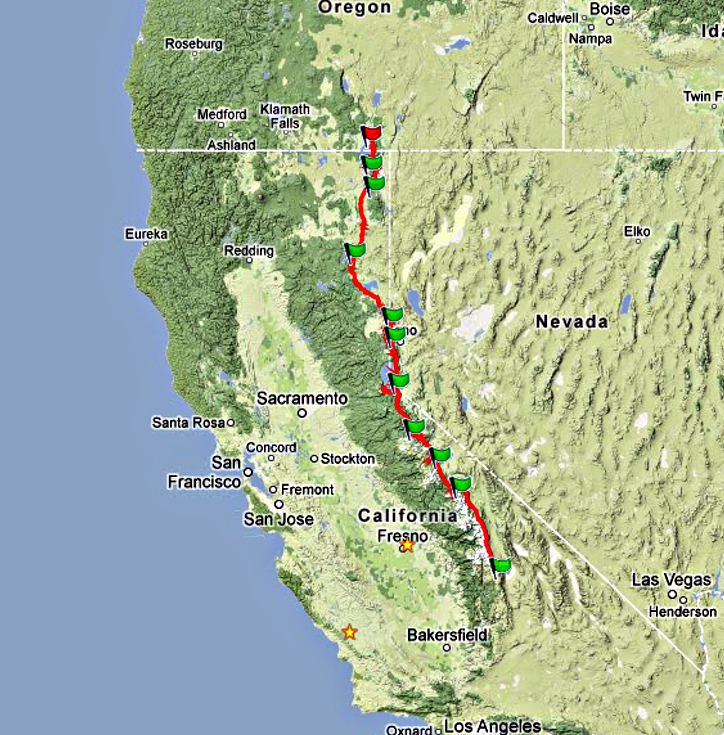
Route of the Sierra Safari Team.
In September of 2012, a bit more than a week before my amazing three days of XC in the Owens Valley, a group of pilots left Lone Pine with a goal that many have dreamed of accomplishing - but few have attempted.  The small gaggle of talented pilots left with the intention of pioneering the route from the Eastern Sierras, North to the Oregon border.  Time constraints, injury, and fatigue all conspired to whittle this group in number, but the team effort paid off.  24 days after launching in souther CA, the border of Oregon was crossed.

The boys camped at high camps and followed routes they had researched on Google Earth.  They endured many discomforts but had a great time doing it.

Here is a short movie that conveys spirit of the trip very well - it also voices the reasons we fly XC in a way that many of us feel, but few can explain.
Tim

Surfing the Sierras from Offshore Odysseys on Vimeo.

Thursday, November 8, 2012

What flying feels like

This video from Jean-Baptiste Chandelier captures the freedom and unstructured joy that a day of flying at the beach offers.  The beginning shot, of the shoes leaving the tarmac, is perfect. . . 

Wednesday, August 10, 2011

Elemental Freedom

Here is a brief video that I found recently.
Nice.

Elemental Freedom from Terry Stubbs Jnr on Vimeo.
"Paragliding will never lose its soul or spirit. The contentment it instils in the heard is too profound."
Pilots - Terry Stubbs Jnr & Zebur Mercan
Location - Bishops Hill, Scotland
Camera - Lumix G10 lens 14-42mm lens
www.terry-stubbs.com


Saturday, May 14, 2011

Serial v. Open Class Revisited

The annual discussion flurry about "Serial V. Open Class Competitions" has flared up this month. . . The ignition point was a letter of resignation from Mark Hayman to Brit team leader Kitt Rudd. In it Mark criticized CIVL for making banal rule changes that essentially did little to improve safety.

Mark writes: “I know, living in the real world, that every time I attach an uncertified two-line glider to my body I am increasing my risk substantially of having an accident over flying a certified wing.”

Mark was participating in Valle de Bravo in 2009 when he watched Stefan Schmoker wrestle with a low collapse and make a fatal impact.  Mark also had a brush with mortality when he had a major event on his R10.2 that included lines wrapping around his neck as he descended under his reserve.

His message has been loud and clear. . . and, as many times happens when one raises the flag of caution, his message seems at times, to be somewhat overstated -  Perhaps so his voice is heard by the resistant masses of enthusiastic pilots who enjoy the sport as it is.

R10.2 line plan
Marks' main point seems to be that the new crop of 2-liner wings are being accepted by CIVL, and being flown by every wanna-be comp pilot, with only a superficial examination of the flying characteristics of these wings.  The prevailing views seem to be that the current crop of 2-liners (essentially a row of A-lines at approximately 25-30% chord - and B-lines at 60% chord) are very collapse resistant when flown well.  The problems become apparent after the wing goes away - the recovery characteristics are just plain bad.  Where as an EN-D (certified) glider is required to recover with proper pilot input, the 'open-class' uncertified wings aren't required to demonstrate recovery.   It's not uncommon to hear of 2000'+ cascades before the wing recovers or the excitement is terminated in a reserve toss.  Mark is simply asking, as am I, IS THIS REALLY THE KIND OF AIRCRAFT BEHAVIOR THAT WE WANT TO PROMOTE?

I've been flying a long time.  I've flown all kinds of aircraft.  But I've always known that if the aircraft departed from "normal flight attitudes" that I could recover without the need to bail-out.  Even the homebuilts - the early fiberglass competition sailplanes that had marginal stability - the 2nd generation swept-wing jets that required 'skills' - they all displayed a required, predictable level of safety and handling.  Mark's primary message is that this is not the case when flying the open-class wings of the last 2 years.

The argument to Mark's point, is that the "good" pilots have no problem on the new wings.  I agree that with the right set of skill, judgment, and luck a good pilot can successfully fly the new wings without incident.  But is that a healthy attitude when considering the sport as a whole?  Let's look at US pylon racing in the 1930s - Speed and performance ruled - The good pilots lived the longest, but even they couldn't fly aircraft that had negative stability and couldn't survive minor equipment failures without fatal consequences.  To compete with the fastest "good" pilots, many other pilots flew similar *dangerous* aircraft and died trying.  Was that the fault of the pilots, or the system that allowed dangerous machines in the air and required others to compete on that "level" playing field?


Pylon races, in spite of their popularity, didn't survive the carnage of 1933 - 1940 and the interuption of a couple of world wars.  Now the few races that are staged in the US are very highly regulated and safety is highly regarded.

So the question becomes one of scale and philosophy.  How many accidents/incidents are to occur before Mark's cautionary message becomes valid?  In my case, he's preaching to the choir. 

In a parallel logic path, the DHV in Germany is making some important moves that may get the parade moving in the right direction. Jorge Ewald translates -
From a post on the German Forum by Ulrich Prinz:

* DHV recognizes the harmonic community of Serial and Open Class pilots in Germany as a good model that may be applicable for FAI-1 events as well: Introduce a Serial class in parallel, crown a Serial Class World Champion. This would prevent pilots from lower qualification countries from giving in to the temptation to fly in the Open class, just to remain competitive. Hence the DHV will now work on the international level to introduce the Serial Class in parallel, rather than to get rid of the Open class. [which is a complete paradigm change, as far as I can see. Great, Mark Hayman - given he stays away from bikes and stairwells long enough to heal - may have a glorious come-back. Mads and other PWC old-timers may feel like after an involuntary ride in a De Lorean, though...]

* DHV (especially Charlie Jöst, their president) will task the DHV technical department with finding new test criteria for competition wings (in collaboration with the other testing houses). This because it is now understood that today's testing criteria are not applicable to competition wings, which were built for actively piloting pilots
It's great to see a European entity, with an official acronym, working in a reasonable fashion to actually make some positive changes in the way Serial class is viewed.  Stay Tuned!

Tim

Sunday, December 19, 2010

Skywalk video competition 2010 Winner!

I embedded this video in August because I felt it conveyed much of the appeal of the sport.  Skywalk agrees.
Congratulations to José Abreu who has won the 2010 Skywalk video competition!
If you have the bandwidth, watch it in HD - Enjoy.


And for those fellow AC/DC lovers, here's a bit more bumpin' video, also from Jose:

Monday, November 29, 2010

Magic Soap

I'm no good at remembering jokes.  I enjoy hearing them - and have an appreciation for humor; I just don't retain the elements of the story in my brain. . . With one notable exception.

Many years ago I was at a small comedy club and an unknown comic took the mike.  He told this joke -
"I was talking to my roommate the other day, about soap.  I told him that soap must be magical.  He said 'Soap isn't magic!  It's just soap!'
I said, Oh yeah? Well think about the soap in the shower. And think about the last thing I wash. . . and the first thing YOU wash. . . It must be magic!"
I've never forgotten that joke.  I think about it, with a chuckle, at least 30% of the times I reach for the soap in my shower.  I don't know why this has 'stuck' for so long, just that it has.  If only all the important lessons in life stuck with the vividness and the humor of that one. . .

Which is why I relate this story.  What I write, on this silly blog, is written with the hope that some of it will resonate and 'stick' with you.  It's my hope that the wheat will show through the chaff and, when you find yourself in need of a good idea in a bad situation, something you've read here will help.

In the meanwhile, Fly Safe -

Tim

Saturday, October 23, 2010

Flying Safe

Copyright ©2010 iStockphoto LP
I say this a lot. "Fly safe."* 

I think this a lot too.  You see, I've never considered having an accident as a reasonable possibility, as long as I "Fly Safe."

I began my flying life at 15, in sailplanes.  I was a skull-full-o-mush, as all 15ers are.  In order to afford my flying lessons, I became the 'airport kid' and worked around the airport - fueling airplanes, working the launch line, cleaning bathrooms etc; and I learned a lot watching the many pilots come and go.  Soon I was towing gliders with a Super-Cub and flying glider rides and intro-lessons.  All the while I was observing other pilots - noticing their different styles and techniques.

I developed an indelible image of the difference between a good pilot  and one who thought he was good.  The 'wanker' assumed he could overcome all variables - but never took the time to think them through.  The good pilots always considered the variables and made sure that the sum added up to a safe operation.  I'm convinced that this lesson saved my life - often - as I negotiated my early flying escapades while experiencing the insanity of puberty.  Applying this lesson has kept me alive during the ensuing 40 years and 25000+ hours.  I've made being a "safe" pilot priority one.  
National Air and Space Museum- Smithsonian Institution
Don't get me wrong - I did my share of stunts, over the early years, and I'm not dumb enough to list them here.  But I've always - even when doing things that I knew were on the fringe of stupid - considered the variables and made an effort to make the right call.  I've NOT done many stunts that just didn't pass my 'safe' test.  


You've all experienced 'Intermediate Syndrome.'  This is a kind of temporary insanity that many experience when they get just enough knowledge and comfort in their abilities to forget about "Flying Safe."
To my chagrin, I experienced a brief Intermediate Syndrome, in paragliders, just before I turned 50, and it resulted in injury.  It took five broken ribs to remind me that paragliders are not toys - they are aircraft that need the respect and consideration given to any other kind of aircraft.

For the last 30 years I've made a living flying airliners.  The most important job of an airline pilot is to consider the many, many, variables and still provide a safe, boring flight to his passengers and crew.  It's hard for me to fly my paraglider with a different mind-set than I do my 747. . . Does that mean that I never fly when conditions aren't optimal?  NO.  Just as in my airline career, I have flown in conditions that pushed (but never exceeded) my experience and aircraft performance.  The secret to increasing your experience level, and comfort in unfamiliar situations, is to do it in baby steps.  It takes time and experience.

So, ask yourself, "Do you Fly Safe?"

What does it mean to "Fly Safe?"

MY definition of a safe pilot is one who I would allow to fly with my family aboard.  Before making the determination of a pilot's "safety," I look at his/her competence and knowledge (experience); mental state; and  motivation on the flight.
  • Does the pilot have the experience to fly in the conditions that exist presently and those that may occur during the flight?
  • Is the pilot experienced enough to anticipate problems and avoid/compensate for these problems?
  • Is the pilot thoughtful in planning the flight and aware of the responsibilities she is assuming?
  • Is the pilot's competency on that aircraft type sufficient?
We have to remind ourselves that there is an important passenger on board, even when we are flying alone ;-)

So, do we "Fly Safe"?

From the standpoint of flying paragliders in Cross-Country events, when I answer that question honestly, I must admit that there are times it appears that I could have flown with more safety.  When I am on a XC flight and get low on the terrain to pull out a save;  When I explore the lee to contact a booming lee-side thermal; When conditions at launch are *sketchy-but-flyable* and I decide to launch before it gets worse;  All of these situations are second-guessable.  The important factor is that I am aware that the safety margins may have been reduced in these situations but, after weighing the applicable variables, have decided it is, indeed, safe.

I know that this appears hypocritical - "It's OK to do dumb things as long as you realize they are dumb."
That's NOT the takeaway here.

What I'm saying is, in the dynamic world of aviation, awareness of your risk at all times, and weighing all the variables, is imperative.  To blindly dive into the lee without a consideration given to the consequences, is idiotic - to fly into the lee after considering the sun angle, winds, and plan of retreat, is "Flying Safe."
In a sport where the prize monies are paltry; the fame is but momentary; and the bragging rights only last for the weekend; ask yourself, "How much are you really willing to dip outside your safety envelope to win a task?"
Answer that question honestly, when in the heat of competition, and you'll know my mindset while competing. Consideration of your risk/reward when it's important is the key.

At the moment I have four friends in physical rehab after flying accidents that occurred while pushing the limits of safety.  I'm sure each of them has a different perspective on the risk/reward calculation than they had prior to pounding.  Please consider their outcomes and daily struggles when you are making critical safety decisions in the heat of battle -
Fly Safe -
Tim
*Even though it's improper English, I live with it.

Tuesday, September 21, 2010

Ask me why I fly . . . I dare ya.

The perspectives available, when flying close to otherwise unviewable landscapes, at slow speed, and hanging from a virtually noiseless machine . . . Sometimes they take my breath away. 

Watch this video and then ask me why I fly paragliders.

Tuesday, August 10, 2010

Once again - Why We Fly

I fly with some cool guys at work.  They have been flying their whole lives and have reached a level in aviation where over 350 people trust them with their lives.  But when these professional pilots find out that I fly these crazy non-structured wings, at high altitudes and for 70+ miles, they are a bit put off.  "How can you risk your life for something so trivial?" they ask -

Well, as I've written here before, I need to get into the air as much as I need to breath the stuff.  It's not a rational thing.  I'm comfortable that I am acquiescing to the irrational.  An artist does the same when he allows his strokes to be spontaneous.  A potter does the same when he whacks an otherwise symmetrical pot to make it unique.  I fly paragliders because they give me wings; and who among us haven't had dreams of flying unencumbered by the limitations of wakefulness.

I just came across a great video that expresses the obsession of paragliding well.  I share in this pilot's addiction, to his fears that one day, I too will be unable to feel the freedom and exhilaration of foot-launched free flight.  "I fly, because I can."


YouTube Link - http://www.youtube.com/watch?v=-r7zKMo3-eA
Fly safe -

Tim

Wednesday, May 5, 2010

Scary Moments and an Appeal

Every one of us has done it.  Had something happen that makes us look around and think. "WOW, that could have been really bad!"  For many it happened in a car.  For most who read this blog - it happened while hanging in a harness and realizing exacly how fast 32'/sec.2 really is.

It might have been a shoddy approach to a sketchy, too small field; or it might have been a collapse right after a mis-timed launch that threatened to swing us viciously into the hill - These are moments we will permanently burn into our flying brain - so that the fact we dodged the bullet - this time - isn't lost on us.  That we are able to fly another day makes us more appreciative of that fact, and more careful to protect that ability.  We've all gotten away with some scary moments.  Every once in a while we don't.

At my first paragliding XC competition, The Rat Race, I met a great guy named Jeff Huey.  He was a top-10 pilot who was a bit older than many of his contemporaries and a respected pilot.  He's generous with his advice and as humble as they come.  He made an impression on me because I had definitely been bitten by the bug and he had attained a level of competence and respect that I aspired to -  Shortly after the comp, it happened.  I heard about his accident through the grapevine.  He had crashed in Mexico while practicing before a comp.  He had broken his back and had profound loss of mobility.  That was 4 years ago.

Jeff has been through a lot since then.  If a man shows his true character while enduring adversity, his character would fill a stadium.  While in pain and confined by his injuries, he still was the great personality and sound advisor at many events.  Well, it's not over for Jeff and he could use some support from the community.  I hope you'll help this friend in need. You can be an encouragement just by writing. Recently one of his fellow "TeamLoser" compadres wrote the following:-
As many are aware, Jeff Huey is paralyzed below his chest as the result of a paragliding accident he suffered in Mexico four years ago. The injury was a broken neck at C7 which required the removal of the broken vertebrae and hardware installed across that area. Jeff’s recovery after his accident has been inspiring! Until recently he has been driving himself to his rehab sessions at the pool, working around the yard and performing all the other tasks we all face daily.

Unfortunately there has been a series of medical complications and setbacks which required Jeff to endure an extended hospital stay with a specialist in Seattle, WA, far from his home in Bend, OR.

The recent problems began with high muscle tone on the left side of Jeff’s body tightening and pulling the ball of his femur out of the socket, which would then go back in place when his body would relax. The socket eventually wore out, creating significant pain where the ball of his femur was wearing through the socket. Jeff can’t necessarily feel pain below his chest at the site of an injury, but his body does and the effects of the pain make his daily routines extremely difficult, or even impossible.

In May 2009, Jeff was injected with a shot to deaden some of his leg muscles to prevent them from pulling the ball from the socket. Unfortunately this didn’t solve the problem, and so in October he underwent surgery to have the ball of his femur removed: the first half of a hip replacement which can be completed if he regains movement in his legs.

But after this surgery severe pain was still present. Images taken of his spine revealed that two more of his vertebrae, T9 and T10, had disintegrated and a third was wearing away. This is right at the point in his middle back where he can move his torso, which created a kind of unsupported hinge which ground away the bones. In January Jeff found a surgeon in Seattle to fuse the vertebrae from T5 to L1. The surgery went well and after a short stay in the hospital he returned to his house in Bend and was doing well with his recovery.

After a short time, however, the recovery took a bad turn and Jeff was again feeling the effects of severe pain. He endured this deteriorating condition for several days before being urged to have things checked out at the local hospital. The following day a new CT scan showed that several of the screws had been pulled from the vertebrae they were anchored to, causing significant damage to those vertebrae. It is likely that the screws pulled out during a transfer from his wheelchair to another surface where he slipped to the floor, but the cause remains unsure.  The next day Jeff was flown Air Life to Seattle to his surgeon and she fused C6 to L1 to span the new injury. Two days into the recovery, while heavily sedated, Jeff fell out of the hospital bed. Apparently the side bar was left down. When found he was in respiratory distress because of fluid on the lungs, requiring yet another trip to the ICU, where tubes were put in to drain the fluid. The fluid turned out to be spinal fluid, so Jeff was fitted with tubing into his spinal column to relieve the pressure. The procedure was successful and Jeff was transported back to Bend to a skilled nursing facility where his recovery may take up to twelve weeks. 

Through it all Jeff remains in good spirit and continues to amaze with his expanding medical knowledge and humor in the face of it all. Jeff has excellent medical coverage, but even so it doesn’t cover all the expenses associated with something like this. While his hospital services were covered his coverage for care at the nursing facility has run out and he will be required to pay $6,000 for the final four weeks of care. He will also have to pay $5,000 out of pocket for his ambulance transport from Seattle back to Bend. In light of his situation we have set up a pay pal account where anyone who feels like helping out can do so.

Pay Pal users can send donations to "jeffh22037 (at) yahoo.com"

Also Jeff is registered on Facebook if you would like to send him some encouragement!

Thanks.

TeamLoser.
Heal well Jeff -

Tim

Saturday, September 19, 2009

Simple things

Point a video camera at the sky, the horizon, hilltops, a bay; allow the world to go by in real time, but record it in 'lapse' time. It sounds simple - and it is; but it accentuates the visual vividness that we all could, simply, experience when seeing.

Another Cloud Reel... from Delrious on Vimeo.


Tim

Wednesday, September 2, 2009

Paragliding and Life -

The '09 XC competition season is essentially over. I have one long weekend in October scheduled for the last BAPA event in the Owens Valley. So I'm back to watching XC Skies and hoping for good flying weather when friends are available and family events allow. I think it is very easy to forget the impact that my activities can have on others. I need to remind myself to be thoughtful of my family, and my wife in particular. Because paragliding is time intensive, and not the most audience friendly sport, I've purposely avoided dragging my wife to the dry, sometimes desolate locations we often site our competitions. For this reason, I spend weeks on the road at comps without the company of my favorite person. Next year I hope to take Mary along on one of the trips to Oregon or Washington, so she can enjoy some of the local sights while I'm out flying with my buddies. . .

I received an email from someone recently that reminded me that simply filling the skies with our colorful wings can have a positive impact on the daily lives of people held firmly to the ground. Sometimes I forget that what we do is, for lack of a better adjective, 'special'. It sometimes takes an exuberant outburst in a retrieve van by Nate Scales, exclaiming, "How COOL is this?! We FLEW today - UP THERE!" to remind me how. . .'Special' what we do can be.
Anyway - Here is the email I received during the US Nationals in Provo, Utah, edited a bit for brevity -
It's going on 3 a.m. and I'm enthralled with your blog and website. I can't wait to see more, read more, and share it with my family. By way of explanation and introduction into my life, my sister, 80 year old Mother, and I live down on Canyon Road in Provo. Our condo has a patio with a straight shot at Squaw Peak. Everyday I spend time with my Mother on the patio enjoying the beauty of Squaw Peak. This week has been a new and incredible journey for us as we view the paragliders. My Dad is buried half way between us and where you are launching in a cemetery that you probably see from the sky. So we put the dog in the car and ride up the hill to the cemetery for a better view. Thursday we saw a big black bird following a couple of you around and around. I wonder if that was you!

Anyway, what I do want you to know is that you and your fellow fliers have brought a lot of joy to some people that you don't know. My Mom is one of them. Her days become very long, and I find that the smallest things give her much happiness. This week I can't wait to hear her call me from the patio saying, "Barbara, come quick. You'll never believe this sight. The sky is dotted with color!!" Then I know that it's time for the paragliders, and we have a new afternoon to enjoy and take in the beauty. Thank you for providing us with wonderment everyday this week. Next week should prove to be pretty boring!

Another person that you have brought happiness to is my friend that lives across the street. His name is Paul, and he is in his 40's and is dying of liver cancer. As we watched you the other day he made the statement, "I would much rather die flying around like that and feeling freedom than I would from cancer." I asked him if paragliding is something that he would put in his "bucket list". He said that he'd love to do it, but medical bills, child support, and being on disability does not allow for that type of a bucket list. He said that he has loved watching the paragliding this week, and that it has given him a sense of freedom in his mind. Paul doesn't know it, but I'm going to check around with some people here in the condos and see if they want to put some money together to give him a tandem ride or something like that at the point of the mountain. I don't even know if there is such a thing, but I'm going to check it out.

Oh my goodness - all I meant to say in this email was thank you for the information, and we hope to come up on Friday or Saturday. It would be wonderful to find you and shake your hand. By the way, I sent emails to the TV stations and the newspapers. Haven't received a reply, but at least I tried.

Thanks for reading my ramblings. I hope you have perfect weather on Friday and Saturday, and I hope that you have much success in the competition. Thank you again for your kind reply. And thank you for adding to the beauty of the earth and touching the lives of those that you don't even know. That is a measure of success.

Fly safe,
Barbara J.
I responded with this:
Dear Barbara -


Thanks for that great note Barbara. I hope you and your mother were able to get a good view of the action on Friday and Saturday. We had a fantastic week of flying - flew 7 out of 7 days, which is unheard of in most competitions due to weather.


It is great to hear that our activities can positively affect others. One of the hardest things to convey to 'non-flyers' is the joy and freedom that we feel when we are flying a cross-country flight. Paragliders are flying machines with no structure other than the rigidity of our own bodies. The wing is moving with the undulations of the air and we fly reactively, like a bird does when he alters his feathers to compensate to changes in airflow. We actually 'touch' the air and use the information we derive tactily to find lift and continue our flight. This joy we feel is an individual, isolated joy, that is seldom shared with others. I often feel that the sport is selfish in some ways because the amazing benefits and joy I get out of the sport are often viewed to be trivial to those that don't share the experience. The fact that you and others have derived some level of appreciation for our activities brings me an additional layer of joy.


I think your effort to get your neighbor, Paul, a paraglider ride is admirable. I have forwarded your email to a couple of instructors I know who enjoyed reading it and also value the sentiments. Go to the North launch at Point of the Mountain any weekend and you will see as many as 30 wings being kited and flown in a family picnic atmosphere.


Thanks again for the note and I hope your mother doesn't find the beauty outside her back porch to be too boring now that we have flown to other sites.


Tailwinds,
Tim O'Neill


So, Fly safe & spread the Joy!

Tim

Monday, July 6, 2009

Progress check

Well let's see. . . "The guy who has the most fun wins."

I try to live by this rule. . .er, recommendation.. . . ah, tenet.

But it's not easy. I mean, I AM having fun most of the time. But I'm a competitive guy, and I'd like to stand on the podium as much as the next guy. It's not that I want to get a trophy (although it's nice, before paragliding, the last I got was when I was 12). And I don't need to win so I can swagger amongst the launch queue. But I want to do my very best at the sport that has my attention.

How do I do that? In short - Practice, Practice, Practice. I need to make good decisions and learn from those that aren't. One of the reasons I started writing this bloggage was so I could relive the tasks that went bad, as much as those that went well. The only way to learn from the bad decisions is to remember them.

In order to plot my progress I've built a crude Excel graph of my placing in the last eight competitions. No compensation has been made for field quality or for the fact that I was on a DHV 1/2 and 2 for most of these comps. My present wing, a Gradient Avax XC2, is an EN-C (almost a 2/3) that I am very comfortable flying. I don't have any qualms flying it in angry conditions because I know what it is saying and how it will react. I also own a Boomerang 5 that I have flown a few times now. The Boom 5 has obviously better performance but isn't a wing that I enjoy flying - right now. The handling seems unresponsive and almost untrustworthy. I imagine that I will get some confidence on the Boom, with time, but until then I will be competing on the Avax XC2 - that includes the U.S. Nat's in Inspo UT in August.

So - looking at the graph, it seems there has been some progress. I'm happy competing and learning while flying in the Serial/Sports class. I'm also getting a taste of the Boom on days that allow some altitude.

Looking forward to Utah next month.

Monday, June 15, 2009

Good Karma Weekend - BAPA Weekend in Dunlap

CLICK ON PHOTOS FOR LARGER VERSION
Imagine this: Your adventure today is to get dropped off somewhere, 20 miles away from home, and get back using your cunning, charms, and skill. . . or bribery – if necessary. This drop off point may be far from a main road; may even be in a pasture far from the farm house (which might be deserted). You won’t even know what the name of the road is, and cell service is doubtful. . . Sound like fun? That is how every cross country paraglider flight may turn out. Often, the real adventures are the events that occur after we land. Sometimes it is less than fun. Sometimes you see the best in people and really enjoy the process – it helps if you have good karma. That’s the way this weekend worked out for me.

This weekend had some of the SoCal crew joining the BAPA XC league regulars in Dunlap. The weather was stellar; great cumulus cloud streets to indicate likely lift sources and very light West winds. The only overdevelopment was East, over the high Sierra, so it was not a factor - perfect weather for XC.

The flying was fun and ‘active’ due to some very strong edges to the thermal cores. I saw my wing do things that I hadn’t seen before – occasionally accordioning and bending midspan in ways that were just ‘wrong.’ I told myself that if I didn’t look up – all was well. The views of the wing aside, nothing scary or uncomfortable occurred and the flying was a lot of fun. That said – My flying basically sucked. My decision making still put me in holes that I had to climb out of and slowed me down. I also landed well short of goal both days.

Saturday’s task was a lap around the Dunlap valley, then out 180 to the pizza joint, then South to Woodlake. I made it into Squaw Valley and decided to fly along a cloud-street that bordered on a stretch of remote country. I did my best but had to land in a field at the South East end of Drum Valley. I actually had landed in this field a couple years ago and hiked about 5 miles before a retrieve driver picked me up. No such retrieve drivers were coming on this trip though. Here’s where the first bout of good karma kicked in:

The ranch I landed at is a full eleven miles from the main road. There was one person within 11 miles of me, when I landed, and he offered a ride into Orosi. He was going to leave until he saw me land, so he waited 15 minutes until I hiked out of the field. His dog, an Aussie Sheppard, named Murphy, kept me company while I packed up. As it turns out, Mike owns the ranch but is working in Sacramento in the Schwartsnegger cabinet. He’s the head man in the state when it comes to State natural resources (parks, water, minerals, etc.) Mike gave me a ride all the way to Orosi. It was an interesting conversation during the ride into town. There I met up with Jay and Shad and we went looking for other pilots. Good karma to them.

The task on Sun. was a leg from Dunlap to Orosi, then up Hwy 63 to the 180 junction, back to launch, then to the ranger station. Josh C. was very patient on Sunday and waited for the gaggle to form before starting his transitions. He basically ran a clinic for a few of us by throttling back. I was with him until a few Km short of the Orosi turnpoint when I managed to find a sink-hole that put me on the deck East of Orosi – 20+ miles from my truck.

Five minutes after getting to the road, a pickup stopped and the driver asked me where I was going. “North,” I said. He asked where I wanted to end up. “My truck is at the Dunlap Community Center.” I responded. “Well, hell’s bells hop in!” he yells, “I’m going to Dunlap myself . . . But I’m drinkin’ beer, ya OK with that?” “SHEYA” I responded, not realizing how many had come before the one in his hand. We (his name was Dean) made a stop in Orange Cove for some kick-ass burritos and then he dropped me off at my truck 40 minutes later. Here’s hoping your back surgery goes well in July, Dean.

I must be living right because both of these retrieves could have been 4 hour fiascos. Instead they were efficient, quick, and enjoyable. If you are ever driving along, and you see a guy next to the road with a floppy hat, sunburned nose, big-bag, neoprene purse, and hard to read sign that says “GLIDER PILOT NEEDS RIDE”, stop and pick me up. Your adventure will be part of mine – hopefully you will enjoy your adventures as much as I do mine.

My flights are HERE

Monday, May 4, 2009

More Musing

I found this quote to be in complete resonance with my paragliding experiences.

Tim
Trips worthy of being called journeys must provide opportunity for virtue. Resourcefulness, judgement, courage and luck must all play their part; temptation must be resisted, false friends identified; skill, analysis and technique must all make a difference. Battle, alliance, rest, fear, thirst, heat, discomfort, reflection and just a few moments of lucidity have to find their place.

The efficiency of a means of transport should be measured by how little you need to travel to still make it a journey; maximise journeys per mile, not miles per hour.

If you are how you travel, remember to maximise your journeys per mile, and only then aim to ramp your miles per life.

From an article
By Tony Curzon Price

Friday, April 10, 2009

Musings

Everyone who lives dies, yet not everyone who dies, has lived. We take these risks not to escape life, but to prevent life escaping us.

One of my fellow PG Forumers has this as his tagline. I like it, even if it sounds a bit trite. At the age of 53, I'm probably ripe for a midlife 'crisis' of some kind, but there are no Harleys, affairs with 25-yr-olds, or tattoos in my near future. I imagine that's because I still feel alive and young enough that death is either going to come spectacularly, or much later on. . .

I guess you could call me a flyer - I've flown some form of aircraft since I was 14 yrs old. For the last 35 years I've made my living flying airplanes. Now, as a 747 pilot I'm more of a manager and less of a pilot. I fly 15 hour international flights that guarantee that I will be tired when making the approach and landing. For that reason, I employ automation and procedures to minimize the opportunity for error. I guess that's why I fly these crazy paraglider competitions.

My slick little paraglider is undoubtedly the lowest performance aircraft I've ever flown - although flying one is the closest thing to spreading my wings and just flying. Paragliders are the easiest aircraft to learn to fly but they take quite a while to learn to fly well. And flying cross country flights is very challenging. I think the challenge is where it's at for me. The focusing nature of being no more than 20 minutes from landing, unless you find lift, keeps me consumed in concentration until I cross the goal line. As I've said before, this sport can seem very trivial to those that 'don't get it' - and I understand. It's just like me 'not getting' why somebody would want to collect Beany Babies . . .

But it doesn't make the impact on my life any less that you, or my wife, don't understand why I do it. My wife does understand (from experience) that if I don't get to fly for a week or two, I get edgy and restless. And I think that she intuitively understands that I need to get into the air - as much as I need to breath the stuff.

What's my point? I don't know, really. I just had my 15 yr. old hound-dog put out of his misery this week. . . He lived a full life and crawled into the garden to die under his favorite tree. I think he was satisfied with his life and lived until he was ready to die. I wish the same for us all.

Tim

Friday, January 30, 2009

World Championship Risks & Rewards

What does it take to compete on the international stage in sport?

Years of preparation?
Commitment?
Top performance equipment?
Risking Life & Limb?


All of the above.

Today a pilot died while competing at the Paragliding World Championships in Valle de Bravo Mexico. This is a very sad event and an indication of what each pilot who competes at this level of paragliding competition must keep in the back of his/her mind.

While I like to tell my friends that XC paragliding is the activity I derive the most enjoyment and reward from, I understand the risks. My risk/reward assessment allows me to continue to fly with confidence and enthusiasm. I do have control of some of the factors: My currency, my familiarity with the area, wing characteristics & safety, the forecast weather. Those risks that I can't control, I minimize or avoid. But many risks are not visible or creep up stealthily.

Mark Hayman says it very well in a recent blog post from the worlds: (written days before the fatality)

"To put it bluntly, top competition pilots in general and particularly competition paraglider pilots are just not normal. Does anybody think that leaping from a hill into angry conditions with your safety assured by 7 kilos of marginally stable sail cloth which at any moment could decide to stop flying, is normal? Let’s face it, most Olympic Athletes or indeed most competitive sports people do not run a very significant risk of death or serious injury each time they participate in their chosen sport. The only things that spring to mind are some forms of motor sport and a few ‘extreme’ sports. In spite of recent advances in equipment and organisation I rarely do a competition where somebody doesn’t ’smack in’, often with quite serious consequences. The fact that we, as pilots, accept this means we are not in any way a ‘normal’ cross section of the population at large. In fact we are pretty weird as far as I can see.
...
So the point I’m making is that the very top guys in a sport where the risk of death or disablement are so high are unlikely to conform to social norms. If they’ve survived the day, they’re likely to drink, smoke or engage in other frowned upon behaviours. If they were unable to control these behaviours and were flying whilst unfit then Darwinian Forces would have removed them from the gene pool long before they’d amassed the thousands of hours flying necessary to be chosen for a National Team and compete in the World Championships."


Mark, in my opinion, does a reasonable job of describing the risks of Top-Level Paragliding XC competition.

Now, let's look at the reward side of the docket:

How many seven figure baseball, cricket, football, players risk life & limb to win? If they did risk it all, and for no money - just the thrill of the game, do you think the same guys would be doing it?

The group I 'hang' with, competitive XC pilots, risk all they are willing to (and more, that is often out of their control) for little or no money. We fly and compete for the thrill and experience and camaraderie. It's not just a hobby. It is the activity we do that somehow gives perspective to the rest of our lives.

So - Today we are one less. A fellow flier has flown his last flight. I hope that the thermals are fat and smooth in the after. I know why he flew and why he accepted the risks. I understand.

Tim

Wednesday, November 26, 2008

Happy Thanksgiving

Here's a bit of a happy tale for you -

I hope you find yourselves in the company of loved ones during the holiday season.

Tim


Original posting was from the NationalReview.com

This is a good story. If a tear comes to your eyes — it's OK.

By Catherine Moore

'Watch out! You nearly broad sided that car!' My father yelled at me. 'Can't you do anything right?' Those words hurt worse than blows. I turned my head toward the elderly man in the seat beside me, daring me to challenge him. A lump rose in my throat as I averted my eyes. I wasn't prepared for another battle.

'I saw the car, Dad. Please don't yell at me when I'm driving.' My voice was measured and steady, sounding far calmer than I really felt.

Dad glared at me, then turned away and settled back. At home I left Dad in front of the television and went outside to collect my thoughts. Dark, heavy clouds hung in the air with a promise of rain. The rumble of distant thunder seemed to echo my inner turmoil.

What could I do about him?

Dad had been a lumberjack in Washington and Oregon. He had enjoyed being outdoors and had reveled in pitting his strength against the forces of nature. He had entered grueling lumberjack competitions, and had placed often. The shelves in his house were filled with trophies that attested to his prowess. The years marched on relentlessly. The first time he couldn't lift a heavy log, he joked about it; but later that same day I saw him outside alone, straining to lift it. He became irritable whenever anyone teased him about his advancing age, or when he couldn't do something he had done as a younger man.

Four days after his sixty-seventh birthday, he had a heart attack. An ambulance sped him to the hospital while a paramedic administered CPR to keep blood and oxygen flowing. At the hospital, Dad was rushed into an operating room. He was lucky; he survived.

But something inside Dad died. His zest for life was gone. He obstinately refused to follow doctor's orders. Suggestions and offers of help were turned aside with sarcasm and insults. The number of visitors thinned, then finally stopped altogether. Dad was left alone.

My husband, Dick, and I asked Dad to come live with us on our small farm. We hoped the fresh air and rustic atmosphere would help him adjust. Within a week after he moved in, I regretted the invitation. It seemed nothing was satisfactory. He criticized everything I did. I became frustrated and moody. Soon I was taking my pent-up anger out on Dick. We began to bicker and argue. Alarmed, Dick sought out our pastor and explained the situation. The clergyman set up weekly counseling appointments for us. At the close of each session he prayed, asking God to soothe Dad's troubled mind. But the months wore on and God was silent. Something had to be done and it was up to me to do it.

The next day I sat down with the phone book and methodically called each of the mental health clinics listed in the Yellow Pages. I explained my problem to each of the sympathetic voices that answered. In vain. Just when I was giving up hope, one of the voices suddenly exclaimed, 'I just read something that might help you! Let me go get the article.' I listened as she read. The article described a remarkable study done at a nursing home. All of the patients were under treatment for chronic depression. Yet their attitudes had improved dramatically when they were given responsibility for a dog.

I drove to the animal shelter that afternoon. After I filled out a questionnaire, a uniformed officer led me to the kennels. The odor of disinfectant stung my nostrils as I moved down the row of pens. Each contained five to seven dogs. Long-haired dogs, curly-haired dogs, black dogs, spotted dogs all jumped up, trying to reach me. I studied each one but rejected one after the other for various reasons, too big, too small, too much hair. As I neared the last pen a dog in the shadows of the far corner struggled to his feet, walked to the front of the run and sat down. It was a pointer, one of the dog world's aristocrats. But this was a caricature of the breed. Years had etched his face and muzzle with shades of gray. His hipbones jutted out in lopsided triangles. But it was his eyes that caught and held my attention. Calm and clear, they beheld me unwaveringly.

I pointed to the dog. 'Can you tell me about him?' The officer looked, then shook his head in puzzlement.

'He's a funny one. Appeared out of nowhere and sat in front of the gate. We brought him in, figuring someone would be right down to claim him, that was two weeks ago and we've heard nothing. His time is up tomorrow.' He gestured helplessly.

As the words sank in I turned to the man in horror. 'You mean you're going to kill him?'

'Ma'am,' he said gently, 'that's our policy. We don't have room for every unclaimed dog.'

I looked at the pointer again. The calm brown eyes awaited my decision. 'I'll take him,' I said.

I drove home with the dog on the front seat beside me. When I reached the house I honked the horn twice. I was helping my prize out of the car when Dad shuffled onto the front porch.

'Ta-da! Look what I got for you, Dad!' I said excitedly.

Dad looked, then wrinkled his face in disgust. 'If I had wanted a dog I would have gotten one. And I would have picked out a better specimen than that bag of bones. Keep it! I don't want it' Dad waved his arm scornfully and turned back toward the house.

Anger rose inside me. It squeezed together my throat muscles and pounded into my temples.

'You'd better get used to him, Dad. He's staying!' Dad ignored me. 'Did you hear me, Dad?' I screamed. At those words Dad whirled angrily, his hands clenched at his sides, his eyes narrowed and blazing with hate.

We stood glaring at each other like duelists, when suddenly the pointer pulled free from my grasp. He wobbled toward my dad and sat down in front of him. Then slowly, carefully, he raised his paw.

Dad's lower jaw trembled as he stared at the uplifted paw. Confusion replaced the anger in his eyes. The pointer waited patiently. Then Dad was on his knees hugging the animal.

It was the beginning of a warm and intimate friendship. Dad named the pointer Cheyenne. Together he and Cheyenne explored the community. They spent long hours walking down dusty lanes. They spent reflective moments on the banks of streams, angling for tasty trout. They even started to attend Sunday services together, Dad sitting in a pew and Cheyenne lying quietly at his feet.

Dad and Cheyenne were inseparable throughout the next three years. Dad's bitterness faded, and he and Cheyenne made many friends. Then late one night I was startled to feel Cheyenne 's cold nose burrowing through our bed covers. He had never before come into our bedroom at night. I woke Dick, put on my robe and ran into my father's room. Dad lay in his bed, his face serene. But his spirit had left quietly sometime during the night.

Two days later my shock and grief deepened when I discovered Cheyenne lying dead beside Dad's bed. I wrapped his still form in the rag rug he had slept on. As Dick and I buried him near a favorite fishing hole, I silently thanked the dog for the help he had given me in restoring Dad's peace of mind.

The morning of Dad's funeral dawned overcast and dreary. This day looks like the way I feel, I thought, as I walked down the aisle to the pews reserved for family. I was surprised to see the many friends Dad and Cheyenne had made filling the church. The pastor began his eulogy. It was a tribute to both Dad and the dog who had changed his life. And then the pastor turned to Hebrews 13:2. 'Be not forgetful to entertain strangers.'

'I've often thanked God for sending that angel,' he said.

For me, the past dropped into place, completing a puzzle that I had not seen before: the sympathetic voice that had just read the right article.

Cheyenne 's unexpected appearance at the animal shelter … his calm acceptance and complete devotion to my father … and the proximity of their deaths. And suddenly I understood. I knew that God had answered my prayers after all. Life is too short for drama & petty things, so laugh hard, love truly and forgive quickly. Live While You Are Alive. Tell the people you love that you love them, at every opportunity. Forgive now those who made you cry. You might not get a second time.

Please share this with someone.

Friday, August 29, 2008

Why do we fly?

I often ask others on the hill what they get out of the sport. The answers vary depending on their skill level, experience, and sanity. The common thread seems to be the freedom and perspective that flying like a bird gives one. Here's a short film entitled "Because" that explores why 'we' do what we do. . .


because... from Ozone Films on Vimeo.

If it doesn't load, try this link:
http://because.flyozone.com/en/shortfilm/ or http://vimeo.com/1345187
This short film was created, written, and directed by Jorge Atramiz and Herminio Cordido, the same minds behind the epic film ‘The Never Ending Thermal‘.Whatever your reason or motivation is to fly, enjoy it!

Thanks to Loren for the link to the HiRes version!

My wrist is healing and I should be fine for the Nat's - Sept. 14th-20th. Looking forward to it.

Tim

Tuesday, January 1, 2008

Happy New Year!


It's 2008, and I'm sitting in Narita on a 6-day trip to Japan & Thailand.

I find myself more inclined to ponder how things are going when I'm alone & away from home. This New Years is no different. I don't make New Years resolutions, but occasionally, I do assess and reflect. 2007 was a tough year for me in some ways. I found myself bitching about my job more than I like. The fact is that I've lost the dream. I'm now resigned to "get on with it" and just do the job. If you were one of my targets for a diatribe - I apologize & hope to not bore you with self-indulgent whining ever again.

This isn't the job it used to be but I'm good at it & it does allow me the time to pursue my passions and spend time with my family & friends. . . even if I'm not always at home when I'd like to be. . . I'm thankful to have the job I've aspired to have since I was 14 years old & started flying.

This New Years I'm very THANKFUL.

Thankful that I have a good woman
who allows me to love her & returns the favor.
I aspire to be a kind, supportive mate.

Thankful that I have two great, grown daughters that have made me proud. They are the sum of their parent's parts, and better for it.
I aspire to be a good father to my adult kids.


Thankful for my friends. Friends provide a feedback loop that is reasonable and helpful. . . and sometimes they even buy the beer.
I aspire to be as good a friend to those I have.

Thankful for my passions. My life is filled with activities that occupy my time & fulfill my need to be challenged, enriched, and educated.
I aspire to improve my skills & expand my horizons. To take risks that will stretch me as a person without impinging on any of the above aspirations.

I hope you all have a great 2008!

Tim