Showing posts with label paragliding. Show all posts

Sunday, April 13, 2014

Flying Cayucos - A new route

Flight from the Dam to the Pier

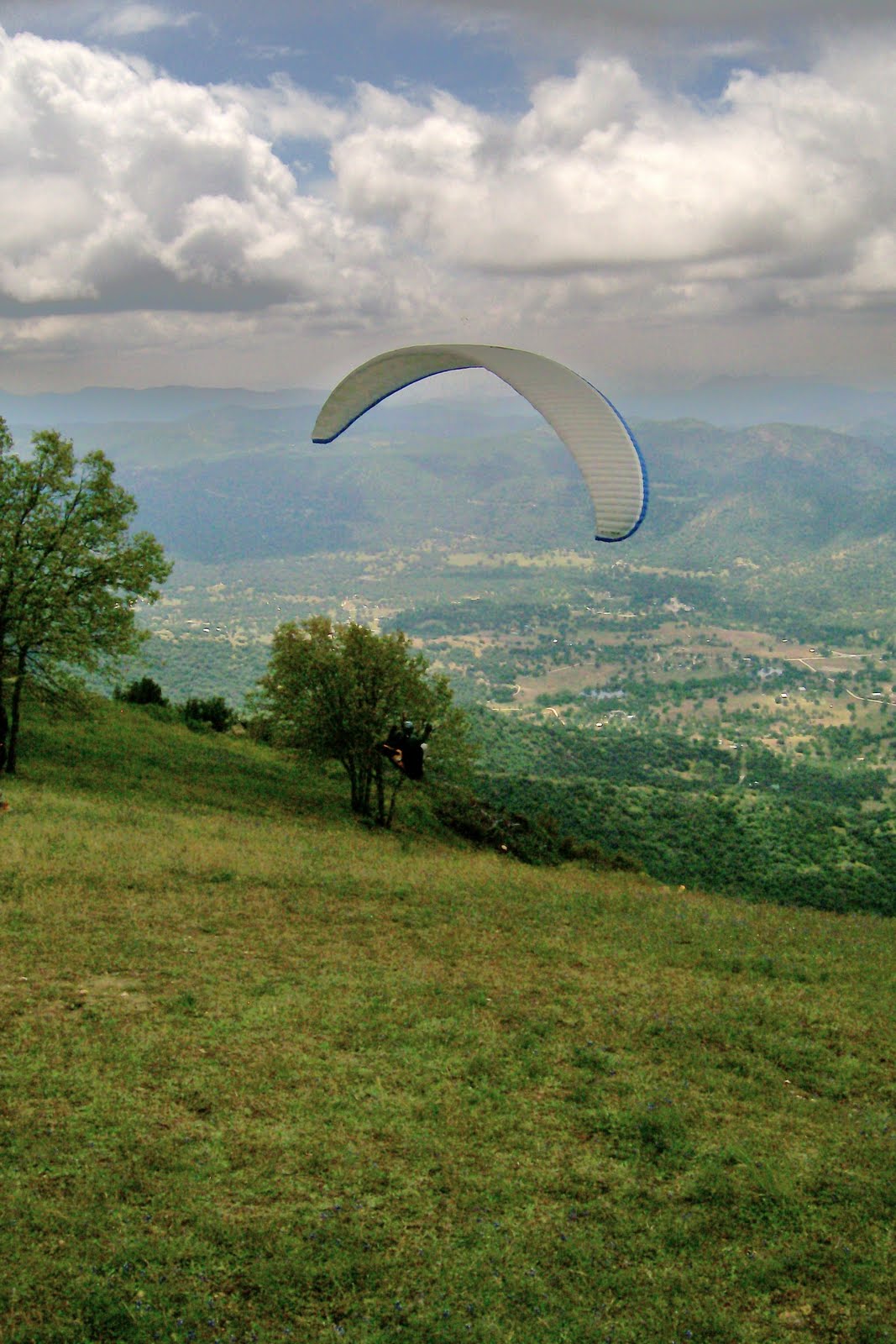
I had the chance to fly a route that I've struggled with, off and on, for years.  The conditions never seemed to come together properly to make the flight possible.  Looking back at it now though, I never pushed to the point of forcing an out-landing North of the dam.

The day was a fairly low day with the occasional bullet thermals allowing climbs to 1100'.   I started off by catching a nice climb into the convergence zone over the main hill.  From then on, it was a low flight back to the dam.  I found a short 100' climb, here and there, which allowed me to work North of the dam and get to the low hill North of the canyon the spillway runs through.  I surfed up the ridge with a juvenile Eagle and the went on a comfortable glide to the Cayucos Pier.

I treated myself to a Smokehouse taco and then hiked the 2 miles back to the base of the hill, where I snagged a ride up for a second round of flying.  Great fun day.  Here's the video -
First time pulling off this tricky route. Beautiful day at Cayucos. 4/11/14


Sunday, December 8, 2013

2014 US XC COMPETITION SCHEDULE

From USHPA Competition Committee Chair, Bill Hughes -

Pending EC approval on a couple of the comps that came in after our meeting, here is the comp calender for 2014 as it stands:

Hang Gliding:
May 18-24: Flytec Americus
June 1-7:    East Coast HG Championship
Aug 3-9:    Big Spring Nationals
Sept 14-20: Santa Cruz Flats

Paragliding:
May 4-10: East Coast PG Nationals (Ground Tow)
June 22-28: Rat Race / Sprint
July 5-12: Chelan Flats
Aug 3-9: Lone Star PG

Wednesday, January 30, 2013

Great Video with an Old Sound Bite

Those who know me well, know I'm an Alan Watts fan.  His writings are fundamental to my outlook on life -

This is a great video interpretation of his well known "Fullfillment" speech.

Fulfilment from Terry Stubbs Jnr on Vimeo.

Fly Safe - Fly high. Tim

Monday, November 29, 2010

Magic Soap

I'm no good at remembering jokes.  I enjoy hearing them - and have an appreciation for humor; I just don't retain the elements of the story in my brain. . . With one notable exception.

Many years ago I was at a small comedy club and an unknown comic took the mike.  He told this joke -
"I was talking to my roommate the other day, about soap.  I told him that soap must be magical.  He said 'Soap isn't magic!  It's just soap!'
I said, Oh yeah? Well think about the soap in the shower. And think about the last thing I wash. . . and the first thing YOU wash. . . It must be magic!"
I've never forgotten that joke.  I think about it, with a chuckle, at least 30% of the times I reach for the soap in my shower.  I don't know why this has 'stuck' for so long, just that it has.  If only all the important lessons in life stuck with the vividness and the humor of that one. . .

Which is why I relate this story.  What I write, on this silly blog, is written with the hope that some of it will resonate and 'stick' with you.  It's my hope that the wheat will show through the chaff and, when you find yourself in need of a good idea in a bad situation, something you've read here will help.

In the meanwhile, Fly Safe -

Tim

Saturday, October 23, 2010

Flying Safe

Copyright ©2010 iStockphoto LP
I say this a lot. "Fly safe."* 

I think this a lot too.  You see, I've never considered having an accident as a reasonable possibility, as long as I "Fly Safe."

I began my flying life at 15, in sailplanes.  I was a skull-full-o-mush, as all 15ers are.  In order to afford my flying lessons, I became the 'airport kid' and worked around the airport - fueling airplanes, working the launch line, cleaning bathrooms etc; and I learned a lot watching the many pilots come and go.  Soon I was towing gliders with a Super-Cub and flying glider rides and intro-lessons.  All the while I was observing other pilots - noticing their different styles and techniques.

I developed an indelible image of the difference between a good pilot  and one who thought he was good.  The 'wanker' assumed he could overcome all variables - but never took the time to think them through.  The good pilots always considered the variables and made sure that the sum added up to a safe operation.  I'm convinced that this lesson saved my life - often - as I negotiated my early flying escapades while experiencing the insanity of puberty.  Applying this lesson has kept me alive during the ensuing 40 years and 25000+ hours.  I've made being a "safe" pilot priority one.  
National Air and Space Museum- Smithsonian Institution
Don't get me wrong - I did my share of stunts, over the early years, and I'm not dumb enough to list them here.  But I've always - even when doing things that I knew were on the fringe of stupid - considered the variables and made an effort to make the right call.  I've NOT done many stunts that just didn't pass my 'safe' test.  


You've all experienced 'Intermediate Syndrome.'  This is a kind of temporary insanity that many experience when they get just enough knowledge and comfort in their abilities to forget about "Flying Safe."
To my chagrin, I experienced a brief Intermediate Syndrome, in paragliders, just before I turned 50, and it resulted in injury.  It took five broken ribs to remind me that paragliders are not toys - they are aircraft that need the respect and consideration given to any other kind of aircraft.

For the last 30 years I've made a living flying airliners.  The most important job of an airline pilot is to consider the many, many, variables and still provide a safe, boring flight to his passengers and crew.  It's hard for me to fly my paraglider with a different mind-set than I do my 747. . . Does that mean that I never fly when conditions aren't optimal?  NO.  Just as in my airline career, I have flown in conditions that pushed (but never exceeded) my experience and aircraft performance.  The secret to increasing your experience level, and comfort in unfamiliar situations, is to do it in baby steps.  It takes time and experience.

So, ask yourself, "Do you Fly Safe?"

What does it mean to "Fly Safe?"

MY definition of a safe pilot is one who I would allow to fly with my family aboard.  Before making the determination of a pilot's "safety," I look at his/her competence and knowledge (experience); mental state; and  motivation on the flight.
  • Does the pilot have the experience to fly in the conditions that exist presently and those that may occur during the flight?
  • Is the pilot experienced enough to anticipate problems and avoid/compensate for these problems?
  • Is the pilot thoughtful in planning the flight and aware of the responsibilities she is assuming?
  • Is the pilot's competency on that aircraft type sufficient?
We have to remind ourselves that there is an important passenger on board, even when we are flying alone ;-)

So, do we "Fly Safe"?

From the standpoint of flying paragliders in Cross-Country events, when I answer that question honestly, I must admit that there are times it appears that I could have flown with more safety.  When I am on a XC flight and get low on the terrain to pull out a save;  When I explore the lee to contact a booming lee-side thermal; When conditions at launch are *sketchy-but-flyable* and I decide to launch before it gets worse;  All of these situations are second-guessable.  The important factor is that I am aware that the safety margins may have been reduced in these situations but, after weighing the applicable variables, have decided it is, indeed, safe.

I know that this appears hypocritical - "It's OK to do dumb things as long as you realize they are dumb."
That's NOT the takeaway here.

What I'm saying is, in the dynamic world of aviation, awareness of your risk at all times, and weighing all the variables, is imperative.  To blindly dive into the lee without a consideration given to the consequences, is idiotic - to fly into the lee after considering the sun angle, winds, and plan of retreat, is "Flying Safe."
In a sport where the prize monies are paltry; the fame is but momentary; and the bragging rights only last for the weekend; ask yourself, "How much are you really willing to dip outside your safety envelope to win a task?"
Answer that question honestly, when in the heat of competition, and you'll know my mindset while competing. Consideration of your risk/reward when it's important is the key.

At the moment I have four friends in physical rehab after flying accidents that occurred while pushing the limits of safety.  I'm sure each of them has a different perspective on the risk/reward calculation than they had prior to pounding.  Please consider their outcomes and daily struggles when you are making critical safety decisions in the heat of battle -
Fly Safe -
Tim
*Even though it's improper English, I live with it.

Saturday, June 5, 2010

When Things Go Bad - Part 2

“Climb if you will, but remember that courage and strength are nought without prudence, and that a momentary negligence may destroy the happiness of a lifetime. Do nothing in haste; look well to each step; and from the beginning think what may be the end”.
(E. Whymper, 1865)

In my last post I emphasized the importance of 'pre-thinking' about your reactions to abnormal and emergency situations. I continue that theme in this post. Again, these are all situations that are avoidable. Do your best to use good judgement to avoid the necessity to employ these procedures.
SCENARIO 4 - Off-field landing
Due to circumstances, (blown back, climbed into a position where you can’t make the ‘normal’ LZ, malfunction that requires a quick landing, etc.) you are going to land in a LZ that is not familiar to you. Congrats! You just went XC!
Your decision to choose an LZ should be made at an altitude that allows time to assess the LZ and plan your approach. When you are making your first few out-landings, please give yourself lots of margin. Plan your approach while fairly high. Use large fields. Long and runway shaped (into the wind) is preferable to short and square. Plan to make a pattern similar to the one you are used to. Once your decision to land out has been made, choose the best field you can safely reach using the following criteria:

• Wind direction – Pick a field that allows a landing into the wind.
• Obstructions and crops – Consider rotors downwind of obstructions. Also choose a field without nasty vegetation and expensive crops. If you must land in crops, attempt to minimize the damage you cause by landing near the edge of the field, or on a road within it.
• Slope – This is secondary to wind direction since it is possible to side-hill land or even land uphill. Landing downhill can be problematic and create an ‘overshoot,’ so pick as level and large a field as possible.
• Wires – Assume the field has wires in it and around it. Look for structures adjacent to the field and look for wires to the structure. Also consider fences when evaluating the field. Barbed-wire fences tend to attract wings after a safe landing.
• Livestock – Ideally, you want to choose a field without any animals in it. Failing that, land as far away from the livestock as possible. Horses are particularly skittish so talk to them as you make your approach and make an attempt to avoid over-flying them.
• Extraction considerations – Look for alternative fields if, for example, you notice a river without bridges between you and the road.

While you are looking over your options, consider a secondary field that you may opt for if your primary choice proves, later, to be unsatisfactory due to wires, crops or other factors.

All factors, short of getting yourself down safely, are of little importance. Land safely and then deal with extraction problems, negotiating with angry land owners etc
.
If you discover on short final, that your field has wires across your path, you must react quickly to avoid hitting the wires. If the electricity doesn’t kill you, the fall will certainly hurt. Consider these alternatives. Land X-wind or downwind to avoid the wires. B-line stall to increase your descent angle into the remaining space prior to the wires. Pick the softest looking trees, bushes, etc. rather than fly into wires. If necessary, consider your gear as expendable. It is better to shred your wing or harness than to wreck your body trying to save your gear.

Landing ‘off-field’ should become something that is not intimidating at all. I consider it to be a valuable skill that needs to be practiced by everyone. Consult your instructor for the first few, though.
SCENARIO 5 - Knot in your Lines
You launch and soon notice a tendency of the wing to turn to the right. Counter steering and wt. shift are sufficient to fly straight, but you have some serious controllability issues.
First, fly away from the hill to provide ground clearance and time to resolve the issue. Use minimum brake inputs since you may be very close to the stall point. Next, remind yourself (by looking and touching) the location of your reserve handle – If you need to toss your reserve this quick review will serve to minimize your response time. Consider flying over an area that is ‘friendly’ to coming down under your rescue canopy. Also consider that your glide ratio may be degraded by the drag created by the deformation of the wing.   Head directly for your LZ while you assess and try to remedy your situation.
.
Now let’s assess the situation. Look at your wing and notice any obvious dimpling of the lower surface. Look for lines that are snagged. Look at your risers to see it the carabiners and speed system are all normal. Use the eyes of your mates to indicate any noticeable defects from above.

You probably have a knot in your suspension lines. Often you can clear a knot by carefully pulling the affected lines and letting them (‘twang”) loose. It may take a few tries – but be cautious, you may cause the wing to spin if you are pulling enthusiastically on one side. Another possibility is that your speed system is hung up on one side. This should be evident by looking at the risers. You might try to activate your speed system (gingerly) to see if that clears the problem.  Another possibility is that your brake line has fouled.  It isn't uncommon to launch with the brakes wrapped in the 'D' lines and this can cause a restriction of the brakes at the pulley.  If controllability to a safe landing is in doubt, consider using your hook-knife to cut the offending brake-line, speed-bar line or rear suspension line.   If clearing the cause of the asymmetry is unsuccessful, then I recommend landing in the largest LZ available. Make your approach as conservative as possible and consider that your controllability may change when slowing for touchdown – even stalling much earlier than normal. Consider landing in a large field without a flare.

An advanced ‘last resort’ technique, which one should only attempt if controllability is really in doubt, and you have a healthy clearance from the surface, is to execute a full stall to release tension on the lines and then pull them tight. If the knot doesn’t come out, the result may be an abnormal recovery/cascade event that will result in a reserve toss.
SCENARIO 6 - Tree Landing
Due to a gross miscalculation, you are going to land in the trees.
Plan your approach so that you impact near the central trunk of the tree. Ideally you should impact with the tree with your legs crossed at the ankles and slowed with a full flare 4-10 feet above the tree branches. Once the noise stops and you complete your string of expletives, assess your situation.

If you are hanging above the forest floor, get secured to the tree. Grab a good branch, then tie on to it as quickly as possible using whatever is available. If there is a possibility of your wing being re-inflated by wind, then do what’s necessary to secure it. I recommend carrying a tree kit (which is accessible while strapped into your harness). It will contain enough webbing to attach your harness to the tree. If you are secure, you might consider waiting for rescue as the safest course of action. If you decide to exit the tree, be sure that you have sufficient equipment to go all the way to the ground - if not, stay put. Some recommend using the reserve parachute lines and bridle to climb down from the tree – I wouldn’t recommend using this method higher than you care to fall.

You can decide your options based upon the gear you have accessible, your situation in the tree, and the distance to the surface. Options to consider are: rappelling from the tree (anchor) while in your harness; rappelling from the harness (anchor) using a separate climbing harness or diaper harness; or even climbing down the tree.

HERE is a great article that explains the hazards and methods of extracting yourself from a tree.
At the very least, have a spool of dental floss in your pocket to lower to the rescue crew. It can be used to pull up a climbing rope.

I highly recommend practicing with your tree kit under controlled conditions. It is trickier than it looks to rappel from the tree and rig the harness for rappel.
SCENARIO 7 - Water Landing
Due to a gross miscalculation, you are going to land in the water.
Just as is a ditching in my airliner, this is a nightmare scenario. The following applies to any water landing, but is particularly true in any type of surf. Your chances of death, when landing in the midst of 30sq. meters of sail and 300+meters of spectra lines, is quite high. You should do everything in your power to avoid a water landing - almost any other scenario is preferable to landing in surf.  This includes crashing in an unsavory place and risking injury. Bear in mind that I am a strong swimmer and this scenario is still VERY intimidating because the gear you are wearing; helmet, boots, multi-layers of clothing - all soak up many pounds of water and will effectively exhaust and drown you. . .

That said, you can do a few things to improve your chances of survival:
  • Carry a hook knife and keep it readily accessible.
  • Once it is obvious that you will be landing in the water, plan your approach so you will hit close to the shore in a (preferred) downwind direction. 
  •  By flying downwind, you are assured that the wing will overfly you and not come down on top of you.  
  • Prior to landing, at an altitude of about 50’, you should remove the brake loops from your wrists, disconnect your leg straps and chest strap, and remove any cockpit attachments (if you think they will hinder your evacuation of the harness). 
  • Plan to fly into the water with no flare, to allow the wing to overfly you. Simultaneously rock forward out of the harness, dive down and escape laterally (towards shore) so as to avoid any lines.
  • Rid yourself of clothing and footwear as soon as you are clear of your lines - You are going to be exhausted in an amazingly short time. 
  • Forget about saving your gear until your safety is assured and you have help. It is amazing how heavy a wing full of water is. If you don’t believe these cautions, watch the video below.


More scenarios at When Things Go Bad Part 3 -
Fly Safe out there.
Tim

Thursday, June 3, 2010

When Things Go Bad - Part 1

What to do when things go bad

This is Part ONE of THREE in this series - Links to the next part are at the end of this page.
I’ve spent much of my life in simulators; often practicing “worst case scenarios.”  While practicing the handling of these types of situations, I work with my crew to utilize the procedures that have been practiced and designed to ensure the proper response.   We also discuss alternative courses of action.  It’s not pessimism that drives this behavior – it’s a healthy respect for the value of mental preparation.   I believe that a similar mindset is valuable in our flying of paragliders.

Even if you never leave your home site, and never land anywhere but your own LZ, “dry flying”  - thinking abnormal scenarios through, can be good practice.

All of the scenarios in this post are situations that are best avoided in the first place.  Use proper preparation and judgment, and you will eliminate the need to deal with these situations.  It is still of value, however, to consider what you would do, to avoid panic and brain-lock, should you encounter them.

Rule number one is KEEP YOUR HEAD.  Don’t stop thinking just because you are confronted with an abnormal situation.  There is a way to handle the situation to minimize your peril and maximize a positive outcome.  Rule number two is TAKE YOUR TIME.  Often the time for ‘immediate action’ has passed – Now you need to make a considered reaction to ensure a safe outcome.

SCENARIO 1 – Parked.
You are soaring at 100 meters (300’) over launch, along your ridge site when the wind picks up suddenly.  You realize you are parked and unable to penetrate into the wind.  What to do?
Assuming that your normal LZ is upwind and below launch, your first course should be to increase your speed to penetrate into the wind.  Use of your speedbar will achieve added ground speed.  If the air is rough, you may not be able to use your speedbar to its full extension, but use as much as you safely can to achieve a visible groundspeed into the wind.  As you get in front of the ridge you will often leave the lift band that can increase the velocity of the wind as it is compressed over the ridge.  You will soon note an increase in your groundspeed.

If you are still parked while accelerated, or unable to use speedbar due to rough air, then you need to explore your other, less attractive options.  You might want to consider descending to the level of the slope in front of launch and side-hill landing.  You may need to land using big-ears to pull this off.  It is often possible (since the wind may be slightly less than 90°  to the ridge) to creep along, parallel to the ridge, so as to get to the end of the ridge and get to an alternative LZ next to the ridge and/or downwind of the ridge.

It also may be a viable alternative to fly over the back to land downwind of the ridge.  You must take into consideration that there may be sink and rotor caused by the wind flowing over the ridge.  You can increase the viability of this choice by utilizing lift on the ridge to get high and choosing your spot to go back carefully, to maximize the distance from the ridge of your landing.  Generally landing as far downwind as possible is your best bet.  Why not take the next thermal over the back and embark on a cross-country flight?  This is a far better choice than panicking and rushing the reaction, or attempting to get to your normal LZ in a vain attempt against the wind. 

You get the idea?  We need to consider these options so they come to mind when you realize you’re in a pickle.

SCENARIO 2 –  High Wind Landing
You have had a great flight and are landing in a stronger wind than expected or comfortable.  
First, plan to land in a LZ with sufficient room to allow for downwind drift, should it be encountered.  Next, plan to land in the upwind 1/3 of the LZ if this has clear air.  When dealing with a lot of wind near the ground, consider any obstructions that may create rotor turbulence.  Make an approach to the LZ that allows you to maneuver without turning away (downwind) from the LZ.  Your approach should be made with the minimum necessary speedbar.  If speedbar is used, then plan to touchdown with minimal bar and then kill the wing by pulling down on your “B” or “C” risers.  An optimum way to achieve a nice high-wind landing is to lean forward slightly, with legs extended and risers ready to pull, so a PLF may be achieved or a quick turn may be made while pulling the “C” risers to kill all lift.   A video of such a landing can be viewed below.  I opted to make the approach and landing without speed-bar since none was necessary.  If speed had been required, I would have landed on the beach since it afforded a bit more space. 

An alternative procedure that I have not employed, but I’ve heard can be successful, is to twist 180° and land while facing backwards so any downwind drift may be handled by running backwards while killing the wing.

SCENARIO 3 – Cloud Suck
You are thermalling up in a nice thermal, when suddenly you realize that you are in rapidly increasing lift and may be sucked into the cloud above, soon. 
As the thermal rises, and the air reaches its dew-point, the increased energy of the thermal can reach a point that causes a climb much faster than intended and anticipated.  Prior to being lifted into the cloud you should attempt to exit the area of lift.  The best way to do this is to roll-out and fly in the direction of the closest edge of the cloud (and the adjacent clear area).  You should have noted the nearest clear area while well below cloud-base since you will not be able to see which direction is best while close to the cloud.  If necessary, use speed-bar and big-ears to increase your speed and sink rate, to evade the lift.  If you have a compass or GPS, use them to provide heading information.  If not, then use the sun as a reference and hold your heading relative to the sun, if possible.  It may be best to hold this heading even if you are lifted into cloud since horizontal escape of the lift is the best method.

Alternative methods are to use descent techniques prior to reaching the cloud.  Big-Ears + Speed-bar, Spirals, and B-Line Stalls are often employed to decrease the effect of the lift.  When exiting these configurations however, you may find yourself climbing in the lift again.  That is why I recommend the first technique.
   
If you find yourself in cloud, do not panic.  It is disorienting and vertigo may be experienced, but you are not in trouble unless you just flew into a 35,000’ thunderstorm.  Just remember that a paraglider has more inherent stability than most flying machines so a hands off approach will suffice to allow you to exit the cloud.  If you can safely fly with some speed-bar, then I recommend you use it to expedite your exit from the cloud.  Be patient – when you get into the sink, you will soon exit the cloud.

A note about spirals - Spirals are a very effective descent technique, but need to be practiced.  I recommend you get with your instructor, or better yet, an SIV coach, to practice ‘throttling’ your spirals so you can effectively modulate the G forces and descent rate.

Part 2 is located HERE.  If you have any suggestions, drop me a note.
Tim

Tuesday, May 25, 2010

BAPA Comp at Dunlap May '10

Dave S. and I headed to Dunlap on Wed. afternoon with the intent to fly 3 days and then participate in the SFBAPA league events over the weekend.  When we arrived at launch the conditions looked perfect for a nice 'shake-out" flight around the valley.  We camped at Dan's LZ and enjoyed a nice dinner up the road at the pub.
Thursday Jug Arrived and we had another fun flight around the valley under great cumulus clouds.  The top-of-climb was low but it was still possible to move around the valley.


Friday was more of the same and I made the decision that I would be flying my Avax XC2 in the weekend comp.  I've decided to fly Serial class in the coming season and have ordered a new Gradient Avax XC3.  The Boomerang 5 is a great wing and I've enjoyed flying it for about 30 hours.  It never did anything squirrelly to me and has great glide performance.  I just didn't connect with the wing.  I didn't trust it and felt that I could actually score better on my XC2 or new XC3.  Maybe I'm not ready for a comp wing yet - I'm OK with that.  I'm firmly of the opinion that we all fly better on wings we are confident in and flying well.  I do know that I can't compete, in the open class, with the latest 2-line wings on a two-year-old Boom 5 so I might as well fly the wings I enjoy flying and that are at the top-end of their class.  


Saturday the troops all assembled at Dan's at 9:30 and we headed up the hill at 10:30.  The conditions were forecast to be good with lift to 6-7000' and a NW wind in the valley.  A task was called from launch to hill 49917 and back, then over Big Cat - and Bald, then a leg to Orosi in the flats for a total of 25 miles.


I had a good high start and barred it all the way to Hill 49917 the lift there was sporadic, but I soon found a thermal pulsing off the hill.  I climbed high enough to get back to launch and caught some lift with the lead gaggle.  We all headed down to Big Cat and then hit the 4km cylinder around Bald Mtn.


A few wings turned directly to Ruth Hill and were struggling low in the shade, so I was looking for alternatives.  To my right (the wrong way to Orosi) was in sunlight and I thought about heading there to poach a bubble off the low hills.  At that same moment, I noticed Josh coming across low to the same area.  He began to circle low in weak lift and I came in on top of him.  The lift was weak but soon bloomed and we climbed together to over 6000' which made it possible to pick our way past the shade at Ruth Hill  and start a relatively straight forward flight to Orosi.  The clouds were working well and lift was often 500-600'/min.  Josh pulled ahead when it was obvious that the flight was going to be easy and beat me to goal by 3 minutes.  Fredric and Steve made it to goal about 30 minutes later and Hoop made a great effort, landing 1km from goal.
Lesson reaffirmed: Don't follow others into conditions that are obviously NOT working.  Look for viable options and try to capitalize on the opportunities they present.
Sunday's task was started in conditions that included low cloudbase and some forecasts of convective activity.  We built a 19 mile task that would put more pilots in goal and keep them in the Dunlap Valley.   After looking over the conditions I decided to launch early to sample the lift and make sure that the convection was reasonable.  Climbs were plentiful and the lift didn't increase in intensity as the cloudbase was approached.   As the start time approached conditions felt better and as we made a glide into Hill 49917 the trend was obviously better.  At that point I just concentrated on the race since I was in the hunt with Josh, Eric, and Fredric.   By the third turnpoint I was in 4th place and the flying was fast.  Josh had stopped to take a climb after Big Cat, on the way to Airstrip, while Eric and Fredric continued into Granny's Knob low.  It looked like they had gotten stuck on the knob, so I took the next 400'/min climb and topped out at around 5500'.  This gave me sufficient height to overfly the guys while they wrestled with sporadic lift, low over the knob.  I was fortunate to pick a great line that actually provided lift as I tagged and returned from the Airstrip.   All I needed for the last 7 miles of the task was one more climb, which I took just short of Big Cat.  I knew Josh was on final glide and Eric was hustling to catch me, but I took the climb at least 1000' too high and had way too much altitude for the final glide.  A rookie mistake, but I still placed second for the day - 4 minutes behind Josh.


I feel very good about the weekend for two reasons.  Firstly; My indecision regarding how I was going to compete this season (and in future seasons)  was resolved, as I sold my Boom 5 on Friday and ordered a new Gradient Avax XC3 on Thursday.  I'm flying serial class for the foreseeable future.

Second; I left the Boom in the bag and flew my three-yr-old Avax XC2 well this weekend and placed 2nd to Josh in both tasks.  I really feel like some of the effort I've put into studying the game is paying off.  

The league has really flourished due to Jug's efforts.  Introducing the Mentoring program and reevaluating the goals of the league to promote the participation and education of newer pilots has revitalized the league.  It's going to be a great season.

Results are HERE.  
and more photos can be viewed HERE

Tim

Friday, October 9, 2009

Flying Pirates

I got to fly a new site today. I've heard about some of the flights at Pirates Cove, so today when Patrick called me, I gladly hiked up to launch. The view was striking and the weather very nice. We flew for an hour or so.

Here's a short video of the fun.

Flying Pirates from Tim O'Neill on Vimeo.

A fun day with Patrick flying Pirates Cove.


Have fun & fly safe -
Tim

Tuesday, September 8, 2009

PWC Superfinal in Poggio Bustone

Those of us relegated to spectator status have something to watch this week. The PWC (Paragliding World Cup) Superfinal is on in Poggio Bustone, Italy - At least that is where they have tried to run the comp - It appears that the weather has been less than cooperative and the participants have been moved to a site near Norma.

So far, three tasks have been flown and scored. The second task was scored after being stopped, and the scoring of this task has created a bit of an anomaly in the overall scores. To read about the comp see the PG Forum topic.

We have pilots from the US participating in the Superfinal. 2009 US Champ, Brad Gunnuscio, as well as Jack Brown, Pete Schaefer, Jeff Wishney, and Bill Hughes all qualified for this elite event. Jack is blogging, when internet connection is available, HERE. Jack is one of the top-ranked US pilots and a fellow airline pilot & Masters class racer - He's giving me hope that an 'old-guy' can compete in this sport. Luca Donini, an 'over 50' Italian, is leading the Superfinal, so that too is encouraging.

There are some great videos of the tasks, from the cockpit of Philippe Broers (a non-competitor) HERE. You can start with THIS video of task one.

Results are HERE.

Good luck guys - Fly safe -

Tim

Friday, July 31, 2009

X-Alps is over. Honza places 3rd!


CLICK ON GRAPHIC FOR LARGER VERSION
Well the Red Bull X-Alps 2009 is over and it was a great race to watch. As I said earlier, this race is quite an adventure. The sacrifices these athletes make to prepare for, and participate in, this race are much more than most modern citizens will ever endure. RESPECT to all the athlete/pilots.

Christian Maurer absolutely outran the field winning by almost two days margin. Alex Hofer placed second and was the only other competitor to make it to the raft in Monaco.

Honza Rajmanek made a late push beyond Aiden Toase and finished a respectable 3rd place. He covered over 1150KM and had an epic journey. I really enjoyed watching this event and am proud of them all.
The event website is HERE.

Tim

Monday, July 6, 2009

Progress check

Well let's see. . . "The guy who has the most fun wins."

I try to live by this rule. . .er, recommendation.. . . ah, tenet.

But it's not easy. I mean, I AM having fun most of the time. But I'm a competitive guy, and I'd like to stand on the podium as much as the next guy. It's not that I want to get a trophy (although it's nice, before paragliding, the last I got was when I was 12). And I don't need to win so I can swagger amongst the launch queue. But I want to do my very best at the sport that has my attention.

How do I do that? In short - Practice, Practice, Practice. I need to make good decisions and learn from those that aren't. One of the reasons I started writing this bloggage was so I could relive the tasks that went bad, as much as those that went well. The only way to learn from the bad decisions is to remember them.

In order to plot my progress I've built a crude Excel graph of my placing in the last eight competitions. No compensation has been made for field quality or for the fact that I was on a DHV 1/2 and 2 for most of these comps. My present wing, a Gradient Avax XC2, is an EN-C (almost a 2/3) that I am very comfortable flying. I don't have any qualms flying it in angry conditions because I know what it is saying and how it will react. I also own a Boomerang 5 that I have flown a few times now. The Boom 5 has obviously better performance but isn't a wing that I enjoy flying - right now. The handling seems unresponsive and almost untrustworthy. I imagine that I will get some confidence on the Boom, with time, but until then I will be competing on the Avax XC2 - that includes the U.S. Nat's in Inspo UT in August.

So - looking at the graph, it seems there has been some progress. I'm happy competing and learning while flying in the Serial/Sports class. I'm also getting a taste of the Boom on days that allow some altitude.

Looking forward to Utah next month.

Friday, June 26, 2009

2009 Rat Race Blogging -

The 2009 Rat Race begins June 28th and runs through the 4th of July. I am not able to fly the Rat Race this year, but here are the RESULTS and some links to good blog resources:

Brett's Blog
ridethecore.com

Alex Colby
http://http://2009ratrace.blogspot.com//

Reaper's Blog
http://hawaiipete.blogspot.com/

Jeff Farrel's Blog
http://blog.superflyinc.com/


I hope a safe and enjoyable event is had by all.

Tim

Wednesday, June 17, 2009

A couple more photos from Dunlap

Thanks to Alex for sending me these two images of our flight last weekend together. Sorry I wasn't able to reciprocate Alex.
CNTRL-CLICK ON PHOTOS FOR LARGER VERSION


Saturday, May 30, 2009

WCPC - Practice Day 2


Today looked unstable early and we all knew it would over-develop before the day was done. The cell above was 20 miles East of us, near Medford, and it was late in the day before any over-development affected the Ruch area.


I launched early again today and got up easily. I headed across to Rabies and soon found a great thermal to 8,500 ft. Most of the collective wanted to go to Grant's Pass again, but I wasn't that motivated to fly the route again. I headed on course but turned and went to the West to make a triangle. I ended up an the Longsword Winery and enjoyed a nice red after packing up. My flight is HERE.

Tonight was sign-in for the WCPC and it looks like most of the regulars are here. Tonight the skies opened up with a very active lightning display and gully-washer rain, so the weather for the week is in doubt. I'm hoping to see some good short tasks early in the week and longer stuff when the instability eases. Wish me luck.

Tim

Monday, May 4, 2009

More Musing

I found this quote to be in complete resonance with my paragliding experiences.

Tim
Trips worthy of being called journeys must provide opportunity for virtue. Resourcefulness, judgement, courage and luck must all play their part; temptation must be resisted, false friends identified; skill, analysis and technique must all make a difference. Battle, alliance, rest, fear, thirst, heat, discomfort, reflection and just a few moments of lucidity have to find their place.

The efficiency of a means of transport should be measured by how little you need to travel to still make it a journey; maximise journeys per mile, not miles per hour.

If you are how you travel, remember to maximise your journeys per mile, and only then aim to ramp your miles per life.

From an article
By Tony Curzon Price

Friday, April 10, 2009

Musings

Everyone who lives dies, yet not everyone who dies, has lived. We take these risks not to escape life, but to prevent life escaping us.

One of my fellow PG Forumers has this as his tagline. I like it, even if it sounds a bit trite. At the age of 53, I'm probably ripe for a midlife 'crisis' of some kind, but there are no Harleys, affairs with 25-yr-olds, or tattoos in my near future. I imagine that's because I still feel alive and young enough that death is either going to come spectacularly, or much later on. . .

I guess you could call me a flyer - I've flown some form of aircraft since I was 14 yrs old. For the last 35 years I've made my living flying airplanes. Now, as a 747 pilot I'm more of a manager and less of a pilot. I fly 15 hour international flights that guarantee that I will be tired when making the approach and landing. For that reason, I employ automation and procedures to minimize the opportunity for error. I guess that's why I fly these crazy paraglider competitions.

My slick little paraglider is undoubtedly the lowest performance aircraft I've ever flown - although flying one is the closest thing to spreading my wings and just flying. Paragliders are the easiest aircraft to learn to fly but they take quite a while to learn to fly well. And flying cross country flights is very challenging. I think the challenge is where it's at for me. The focusing nature of being no more than 20 minutes from landing, unless you find lift, keeps me consumed in concentration until I cross the goal line. As I've said before, this sport can seem very trivial to those that 'don't get it' - and I understand. It's just like me 'not getting' why somebody would want to collect Beany Babies . . .

But it doesn't make the impact on my life any less that you, or my wife, don't understand why I do it. My wife does understand (from experience) that if I don't get to fly for a week or two, I get edgy and restless. And I think that she intuitively understands that I need to get into the air - as much as I need to breath the stuff.

What's my point? I don't know, really. I just had my 15 yr. old hound-dog put out of his misery this week. . . He lived a full life and crawled into the garden to die under his favorite tree. I think he was satisfied with his life and lived until he was ready to die. I wish the same for us all.

Tim

Thursday, March 19, 2009

PodMod Pt. 2

A week ago I started my mod of my harness, by adding a pod. You can see Part One HERE. I've also made a few additional changes.
I've had a couple flights with my pod installed and really like the product so far. I am not totally satisfied with the mod, yet, though. I have encountered a couple problems.

1. The top (front) of the skirt has a lot of weight due to the front mounted reserve. This creates an issue when launching and groundhandling. When the risers are not under load, the pod skirt tends to fall forward over the carabiners. There is also a lot of stress on the seams where the carabiners support the pod.

2. When activating the speed bar (a 3-step UP ladder type) my heel tends to rub with much friction on the bottom surface of the pod. The XC2 has a very stiff push to activate the speed-bar already and the additional friction makes using the bar almost impossible and may cause wear of the pod.
Click on each photo for a larger view

To remedy the issues I added a strip of 1" webbing along the opening for the carabiners that crosses both seams to strengthen them.


I also added a strip of velcro that is wrapped around the carabiner and holds the skirt in place when the risers are not held vertical.


To fix my second issue I laid a 1/16" thick plastic cutting board, trimmed to shape, that fit between the piping at the floor seams. Sewn to the seams was a strip of 1" velcro, which holds the plastic in place, as well as physically capturing the plastic sheet.


Next I sewed a loop to the nosepiece which allows a 1/8" bungee to hold the stirrup in position for easy access.


Here's the completed stirrup set-up.

I'll be flying the new mods soon & hope to have a workable system before the first comp of the season.

Tim

Thursday, March 12, 2009

PodMod

Well, if you were to have read an entry from late Dec. '08, you might remember a post labeled 'Project Time'. I had ordered a leg covering, or POD, from UP. UP is a paraglider producer in Germany. Somewhere along the line things got lost in translation between my supplier and UP for the last 3 months. I'd like to thank Rob and Ty at Eagle Paragliding for staying on things so that the outcome was successful. It isn't unusual for the PG supply pipeline to have some kinks and clogs in it, but Rob is a good expediter and a stand-up guy.

My goal was to add the pod and make whatever modifications to the harness were necessary to do this, BUT I wanted the ability to fly the harness without the pod if I chose to. Since the leg cover mounts to the bottom of the harness I had to move my reserve to the front mounted position. For this reason I ordered the version with the integral reserve container. Moving the reserve was straight forward. The pod has bridle routes that cover the bridle on either side.

The UP Speed cover is made of good quality materials and appears to be fairly durable. It consists of a stretchy material on the top surface of the pod (with the split for entry/exit from the pod) and a light but sturdy Nylon fabric for the sides and bottom of the pod. A heavy-duty zipper is used to join the front of the pod at the waist strap between the carabiners.

The nose cone on this pod has a 2in. hole that allows ram air to inflate the cone. The bottom surface of the pod skirt has Velcro sewn into the skirt to facilitate attachment to the harness. I sewed strips of mating velcro to the harness, just forward of the Ram Race's tailpiece ram-air intakes.

Because the bulk of the front mounted reserve makes it impossible to use my existing flight deck I made my own instrument deck that mounts to the Velcro on the reserve container.

I stand 69in. and 175 lbs. and the Medium size is perfect for me. Anyone taller should opt for the large. The video below shows some of the details of the mod.

The complete project took less than 4 hours and $25 for professional sewing. The results are a good looking and comfortable leg covering. This pod looks like it would work on a number of similar harnesses.

I made some additional changes after flying a couple flights.
They can be seen HERE.


PodMod from Tim O'Neill on Vimeo


I can't wait to fly it. I hope to get a chance this weekend at the Santa Barbara event.

Tim

Friday, November 28, 2008

2009 U.S. Paragliding Competition Schedule

From the USHGA website, I have gleaned the following Competition Schedule for the 2009 season:
The website addresses are correct - They may not be up yet, however.

Sierra National Challenge-US PG Nationals (Dunlap, CA)

4/26/2009 through 5/3/2009
Website: http://santacruzparagliding.com/

West Coast Paragliding Championships (Woodrat, OR)

5/31/2009 through 6/6/2009
Website: www.mphsports.com

Rat Race Paragliding Competition (Woodrat, OR)

6/28/2009 through 7/4/2009
Website: www.mphsports.com

US Paragliding Nationals (Squaw Peak, UT)

8/16/2009 through 8/22/2009
Website: http://usparaglidingnats.com

The first and last meets of the year, (Dunlap, CA and Squaw Pk., UT) will comprise the "US Nationals." Their scores will be combined (with a throw-away option) to determine the US Champion.