We are only two weeks away from the heart of the U.S. Paragliding competition circuit. 2010 is a special year since the schedule includes a PWC event and a Pre-PWC event. It all starts July 10th with the Chelan XC Open. I flew this event 2 years ago, when it was a Pre-PWC event and had a great time. I flew a great 75 mile triangle to make goal and really had a ball. Unfortunately I won't be able to get the time-off necessary to fly this event. . . I will keep track of the results here though. Good luck to all and FLY SAFE. Info about the comp can be found at http://www.chelanxcopen.com
What's great about the site, in Chelan, is that it has a great mountain launch with a dramatic exposure of the Columbia River Gorge and XC possibilities to the South, East and North. To the East is a high plain of some of the best XC flats I've ever flown. Unlimited landing spots, epic climbs to above 10,000', and dusties that you can see for 20 miles make this a place to remember.
Following the Chelan XC Open, Chelan will host the first PWC (Paragliding World Cup) event to be held in the USA in 12 years. PWC events attract the best pilots from all over the world and are the highest level of Paragliding XC competition. I am really looking forward to flying with the best and brightest. This will also be my first opportunity to see the newest, exotic 2-liner wings from Ozone, Niviuk, and SOL.
I will be flying my new Gradient Avax XC3 which is a new Serial Class wing, and lower performance than the majority of the wings entered in the PWC. My goals and expectations involve getting to goal every day and making good decisions while learning all I can about tactics and strategies from the great pilots I'll be surrounded by. I will be posting regularly, while flying in this great competition.
In August we will travel to Sun Valley, Idaho for the US Nat's. I've never flown Sun Valley, but the site looks great. This event will also be a Pre-PWC event.
My Gradient Avax XC3 should be here soon and I hope to get familiar with it before flying it in anger at the PWC ;-)
Tim

Flight descriptions, Competition tips, recap of results, and US competition schedule.
Sunday, June 27, 2010


Wednesday, June 23, 2010
When Things Go Bad - Part 3
In prior posts I went through a few scenarios and recommended some possible solutions and procedures to consider when faced with these abnormal situations. The main thing we are after, in looking at these situations is the ability to think and fly while working through the problem to it's safest outcome. As mentioned before, all of these equipment and grey-matter failures can be avoided if you are conscientious with your gear, preparation, and anticipation of potential danger.
 No Problem. You will still have plenty of control to safely get on the ground. As your instructor (probably) told you during training, you can use your rear risers to control the wing. Because you want similar control pressures, I recommend using both rear risers rather than using one brake and the opposite riser. Be careful since the force required to control the wing may be different than that normally experienced while using brakes - consider the possibility of stall/spin, if over controlling.
Practice rear-riser-flying your wing every once in a while to familiarize yourself with the flying characteristics and control pressures associated with using the rear risers for control.
When you tie your brake line knots I recommend using the knot shown in the graphic here. Click on the graphic for a larger version.
 This may sound a bit far-fetched, but I've seen a variation of this happen at three different towing events. Any time you combine a boat, a winch, a long towing line, and a wing, you add innumerable complex failure points and something is bound to happen. This means you need to be prepared and all parties need to have a plan.
When on tow, and the line goes very slack, (you realize something is ending the tow prematurely) your first thought should be to disconnect from the tow-line. You may need two hands to accomplish this task since the force has been removed from the line. Your priority should be to clear yourself from the tow-line. Then steer towards a suitable landing spot while considering the wind. If you are in a position where landing in the water is the best or only option, get as close to another boat or shore as possible. If your safety boat has been disabled you may be in the water for a while.
Scenario 7 covered some of the things to consider, and preparations to make, when landing in the water. You may think that the water is your friend since the whole reason for the course being held at the lake is so you will land in the water if the wing gets out of sorts - but the hazards of the water are as real as any other time.
So - Here's the way to preemptively avoid the above situation. If your acro-god instructor doesn't brief you (and the boat driver) about the tow pattern and the importance of a path that allows for a landing on shore if a low rope-break or boat malfunction occurs, you need to take responsibility for your safety, and do the briefing with them. If, as is the case most of the time, your tow-boat is also the safety boat, there is a gap in safety if the boat is disabled due to engine or winch problems. You shouldn't be exposed to a water landing for any longer than necessary, early in the tow. The best-case scenario is for you to be towed along a landable shoreline until you are high enough to return to a designated LZ. If you find yourself headed for the water then all the caveats mentioned in Scenario 7 apply.
For some very sobering information, see this excellent study done by the DHV. It is obvious, from this study, that a timely arrival of the safety boat is imperative to a safely run SIV course.
SIV courses are very important in advancing your flying through increased familiarity and confidence in your ability to handle your wing in all situations - I value my time over the water greatly - but be aware that it is essential that your SIV is conducted by professionals who have good equipment and good procedures.
Fly Safe -
Tim
SCENARIO 8 - Brake Handle Separation
You huck off the hill with your brakes held in your normal way; When you pull the right brake, the handle separates from the brake-line, and your brake-line trails 10 feet behind you as you fly along.

Practice rear-riser-flying your wing every once in a while to familiarize yourself with the flying characteristics and control pressures associated with using the rear risers for control.
When you tie your brake line knots I recommend using the knot shown in the graphic here. Click on the graphic for a larger version.
SCENARIO 9 - Tow Boat Disabled
You are attending your first SIV course, held at a local lake. The instructor is a well respected acro pilot who gets right to the description of how/what/where you are going to do the maneuvers. You excitedly hook into the tow-line and are soon airborne. The boat tows you to about 200', when you feel the line go slack and you see the boat slowing until it's dead in the water.

When on tow, and the line goes very slack, (you realize something is ending the tow prematurely) your first thought should be to disconnect from the tow-line. You may need two hands to accomplish this task since the force has been removed from the line. Your priority should be to clear yourself from the tow-line. Then steer towards a suitable landing spot while considering the wind. If you are in a position where landing in the water is the best or only option, get as close to another boat or shore as possible. If your safety boat has been disabled you may be in the water for a while.
You should be wearing a good life vest. You should have removed the padding from your harness so you float face-up. You should have a hook knife readily available. And you should have a plan if you hit the water without the aid of a rescue boat; because. . .
The very reason you are heading for the water, may be the reason the rescue boat won't be coming to your aid! If you are fouled in your lines, you are in serious danger, since no rescue boat is coming.
Scenario 7 covered some of the things to consider, and preparations to make, when landing in the water. You may think that the water is your friend since the whole reason for the course being held at the lake is so you will land in the water if the wing gets out of sorts - but the hazards of the water are as real as any other time.
So - Here's the way to preemptively avoid the above situation. If your acro-god instructor doesn't brief you (and the boat driver) about the tow pattern and the importance of a path that allows for a landing on shore if a low rope-break or boat malfunction occurs, you need to take responsibility for your safety, and do the briefing with them. If, as is the case most of the time, your tow-boat is also the safety boat, there is a gap in safety if the boat is disabled due to engine or winch problems. You shouldn't be exposed to a water landing for any longer than necessary, early in the tow. The best-case scenario is for you to be towed along a landable shoreline until you are high enough to return to a designated LZ. If you find yourself headed for the water then all the caveats mentioned in Scenario 7 apply.
For some very sobering information, see this excellent study done by the DHV. It is obvious, from this study, that a timely arrival of the safety boat is imperative to a safely run SIV course.
SIV courses are very important in advancing your flying through increased familiarity and confidence in your ability to handle your wing in all situations - I value my time over the water greatly - but be aware that it is essential that your SIV is conducted by professionals who have good equipment and good procedures.
Fly Safe -
Tim
Tuesday, June 15, 2010
Like a kid on Christmas Eve -
That's me. I'm waiting for my new Gradient Avax XC-3 to arrive. The early reports are very positive and the performance is being touted as 'much better' than the XC-2, which I was very impressed with. When I ordered the XC-2 (3 years ago) I was concerned that it would be too hot for me. I was very happy with the handling and benign flight characteristics and it was perfect for my stage of development, as a paraglider pilot.
Now, I'm ready for anything that Gradient can get by the EN-D testing. And I'm ready to enjoy the great handling I've come to expect from the Gradient team. I won't be worried about competing against the ultra-specialized, exotic, 2-liner comp wings rolling off the factory floors - I'm a serial guy, and happy to be flying a little less performance with much better handling.
Now, I'm ready for anything that Gradient can get by the EN-D testing. And I'm ready to enjoy the great handling I've come to expect from the Gradient team. I won't be worried about competing against the ultra-specialized, exotic, 2-liner comp wings rolling off the factory floors - I'm a serial guy, and happy to be flying a little less performance with much better handling.
I didn't want to complicate my order, so I went with the stock blue colors. It should be here within a couple weeks. I plan to fly it in the US Nat'ls in Sun Valley in August, and the PWC in Chelan, WA in July.
The XC3 is advertised as having a better-than 10:1 glide ratio with a nice wide speed range that exceeds 60Kph accelerated. The 6.8 aspect ratio is right between that of the XC2 and the Boomerang 5 I flew this year. The 3-line configuration eliminated almost 25% of the line length (read drag) and it looks like the line diameters haven't been increased substantially, like they have been on the 2-line designs.
More info to come when I get a chance to wring it out -
Here's a nice video of the XC-3 in flight.
The XC3 is advertised as having a better-than 10:1 glide ratio with a nice wide speed range that exceeds 60Kph accelerated. The 6.8 aspect ratio is right between that of the XC2 and the Boomerang 5 I flew this year. The 3-line configuration eliminated almost 25% of the line length (read drag) and it looks like the line diameters haven't been increased substantially, like they have been on the 2-line designs.
More info to come when I get a chance to wring it out -
Here's a nice video of the XC-3 in flight.
Friday, June 11, 2010
Rat Race folks

This paragliding competition is a great event that is geared to the newer XC pilot who wants to experience the competition scene in a less intense and more instructive environment. A mentoring program pairs experienced pilots with those who are new to the sport. Safety is emphasized and tasks are designed to provide challenging but safe routes through the Oregon hills.
Unfortunately my work schedule doesn't allow me to fly this comp in 2010. Fly Safe and have fun!
For those of you looking for a map of the waypoints in the Woodrat area, HERE is one I built a few years back.
If you haven't seen it yet, I've written an article geared to newer XC comp pilots and it can be downloaded HERE.
I wrote and article for the Rat Race Pilot Handout a couple years back (not sure if it's still included) and it can be read HERE
The official Rat Race Website is HERE.
Official Rat Race Results are HERE
I hope the week is as instructive and enjoyable for you, as every Rat Race I've flown has been for me.
Tim
.
Saturday, June 5, 2010
When Things Go Bad - Part 2
“Climb if you will, but remember that courage and strength are nought without prudence, and that a momentary negligence may destroy the happiness of a lifetime. Do nothing in haste; look well to each step; and from the beginning think what may be the end”.
(E. Whymper, 1865)
In my last post I emphasized the importance of 'pre-thinking' about your reactions to abnormal and emergency situations. I continue that theme in this post. Again, these are all situations that are avoidable. Do your best to use good judgement to avoid the necessity to employ these procedures.
SCENARIO 4 - Off-field landing
Due to circumstances, (blown back, climbed into a position where you can’t make the ‘normal’ LZ, malfunction that requires a quick landing, etc.) you are going to land in a LZ that is not familiar to you. Congrats! You just went XC!Your decision to choose an LZ should be made at an altitude that allows time to assess the LZ and plan your approach. When you are making your first few out-landings, please give yourself lots of margin. Plan your approach while fairly high. Use large fields. Long and runway shaped (into the wind) is preferable to short and square. Plan to make a pattern similar to the one you are used to. Once your decision to land out has been made, choose the best field you can safely reach using the following criteria:
• Wind direction – Pick a field that allows a landing into the wind.
• Obstructions and crops – Consider rotors downwind of obstructions. Also choose a field without nasty vegetation and expensive crops. If you must land in crops, attempt to minimize the damage you cause by landing near the edge of the field, or on a road within it.
• Slope – This is secondary to wind direction since it is possible to side-hill land or even land uphill. Landing downhill can be problematic and create an ‘overshoot,’ so pick as level and large a field as possible.
• Wires – Assume the field has wires in it and around it. Look for structures adjacent to the field and look for wires to the structure. Also consider fences when evaluating the field. Barbed-wire fences tend to attract wings after a safe landing.
• Livestock – Ideally, you want to choose a field without any animals in it. Failing that, land as far away from the livestock as possible. Horses are particularly skittish so talk to them as you make your approach and make an attempt to avoid over-flying them.
• Extraction considerations – Look for alternative fields if, for example, you notice a river without bridges between you and the road.
While you are looking over your options, consider a secondary field that you may opt for if your primary choice proves, later, to be unsatisfactory due to wires, crops or other factors.
All factors, short of getting yourself down safely, are of little importance. Land safely and then deal with extraction problems, negotiating with angry land owners etc
.
If you discover on short final, that your field has wires across your path, you must react quickly to avoid hitting the wires. If the electricity doesn’t kill you, the fall will certainly hurt. Consider these alternatives. Land X-wind or downwind to avoid the wires. B-line stall to increase your descent angle into the remaining space prior to the wires. Pick the softest looking trees, bushes, etc. rather than fly into wires. If necessary, consider your gear as expendable. It is better to shred your wing or harness than to wreck your body trying to save your gear.
Landing ‘off-field’ should become something that is not intimidating at all. I consider it to be a valuable skill that needs to be practiced by everyone. Consult your instructor for the first few, though.
SCENARIO 5 - Knot in your Lines
You launch and soon notice a tendency of the wing to turn to the right. Counter steering and wt. shift are sufficient to fly straight, but you have some serious controllability issues.First, fly away from the hill to provide ground clearance and time to resolve the issue. Use minimum brake inputs since you may be very close to the stall point. Next, remind yourself (by looking and touching) the location of your reserve handle – If you need to toss your reserve this quick review will serve to minimize your response time. Consider flying over an area that is ‘friendly’ to coming down under your rescue canopy. Also consider that your glide ratio may be degraded by the drag created by the deformation of the wing. Head directly for your LZ while you assess and try to remedy your situation.
.
Now let’s assess the situation. Look at your wing and notice any obvious dimpling of the lower surface. Look for lines that are snagged. Look at your risers to see it the carabiners and speed system are all normal. Use the eyes of your mates to indicate any noticeable defects from above.
You probably have a knot in your suspension lines. Often you can clear a knot by carefully pulling the affected lines and letting them (‘twang”) loose. It may take a few tries – but be cautious, you may cause the wing to spin if you are pulling enthusiastically on one side. Another possibility is that your speed system is hung up on one side. This should be evident by looking at the risers. You might try to activate your speed system (gingerly) to see if that clears the problem. Another possibility is that your brake line has fouled. It isn't uncommon to launch with the brakes wrapped in the 'D' lines and this can cause a restriction of the brakes at the pulley. If controllability to a safe landing is in doubt, consider using your hook-knife to cut the offending brake-line, speed-bar line or rear suspension line. If clearing the cause of the asymmetry is unsuccessful, then I recommend landing in the largest LZ available. Make your approach as conservative as possible and consider that your controllability may change when slowing for touchdown – even stalling much earlier than normal. Consider landing in a large field without a flare.
An advanced ‘last resort’ technique, which one should only attempt if controllability is really in doubt, and you have a healthy clearance from the surface, is to execute a full stall to release tension on the lines and then pull them tight. If the knot doesn’t come out, the result may be an abnormal recovery/cascade event that will result in a reserve toss.
SCENARIO 6 - Tree Landing
Due to a gross miscalculation, you are going to land in the trees.

If you are hanging above the forest floor, get secured to the tree. Grab a good branch, then tie on to it as quickly as possible using whatever is available. If there is a possibility of your wing being re-inflated by wind, then do what’s necessary to secure it. I recommend carrying a tree kit (which is accessible while strapped into your harness). It will contain enough webbing to attach your harness to the tree. If you are secure, you might consider waiting for rescue as the safest course of action. If you decide to exit the tree, be sure that you have sufficient equipment to go all the way to the ground - if not, stay put. Some recommend using the reserve parachute lines and bridle to climb down from the tree – I wouldn’t recommend using this method higher than you care to fall.
You can decide your options based upon the gear you have accessible, your situation in the tree, and the distance to the surface. Options to consider are: rappelling from the tree (anchor) while in your harness; rappelling from the harness (anchor) using a separate climbing harness or diaper harness; or even climbing down the tree.
HERE is a great article that explains the hazards and methods of extracting yourself from a tree.
At the very least, have a spool of dental floss in your pocket to lower to the rescue crew. It can be used to pull up a climbing rope.
I highly recommend practicing with your tree kit under controlled conditions. It is trickier than it looks to rappel from the tree and rig the harness for rappel.
SCENARIO 7 - Water Landing
Due to a gross miscalculation, you are going to land in the water.Just as is a ditching in my airliner, this is a nightmare scenario. The following applies to any water landing, but is particularly true in any type of surf. Your chances of death, when landing in the midst of 30sq. meters of sail and 300+meters of spectra lines, is quite high. You should do everything in your power to avoid a water landing - almost any other scenario is preferable to landing in surf. This includes crashing in an unsavory place and risking injury. Bear in mind that I am a strong swimmer and this scenario is still VERY intimidating because the gear you are wearing; helmet, boots, multi-layers of clothing - all soak up many pounds of water and will effectively exhaust and drown you. . .
That said, you can do a few things to improve your chances of survival:
- Carry a hook knife and keep it readily accessible.
- Once it is obvious that you will be landing in the water, plan your approach so you will hit close to the shore in a (preferred) downwind direction.
- By flying downwind, you are assured that the wing will overfly you and not come down on top of you.
- Prior to landing, at an altitude of about 50’, you should remove the brake loops from your wrists, disconnect your leg straps and chest strap, and remove any cockpit attachments (if you think they will hinder your evacuation of the harness).
- Plan to fly into the water with no flare, to allow the wing to overfly you. Simultaneously rock forward out of the harness, dive down and escape laterally (towards shore) so as to avoid any lines.
- Rid yourself of clothing and footwear as soon as you are clear of your lines - You are going to be exhausted in an amazingly short time.
- Forget about saving your gear until your safety is assured and you have help. It is amazing how heavy a wing full of water is. If you don’t believe these cautions, watch the video below.
More scenarios at When Things Go Bad Part 3 -
Fly Safe out there.
Tim
Thursday, June 3, 2010
When Things Go Bad - Part 1
What to do when things go bad
This is Part ONE of THREE in this series - Links to the next part are at the end of this page.
I’ve spent much of my life in simulators; often practicing “worst case scenarios.” While practicing the handling of these types of situations, I work with my crew to utilize the procedures that have been practiced and designed to ensure the proper response. We also discuss alternative courses of action. It’s not pessimism that drives this behavior – it’s a healthy respect for the value of mental preparation. I believe that a similar mindset is valuable in our flying of paragliders.Even if you never leave your home site, and never land anywhere but your own LZ, “dry flying” - thinking abnormal scenarios through, can be good practice.
All of the scenarios in this post are situations that are best avoided in the first place. Use proper preparation and judgment, and you will eliminate the need to deal with these situations. It is still of value, however, to consider what you would do, to avoid panic and brain-lock, should you encounter them.
Rule number one is KEEP YOUR HEAD. Don’t stop thinking just because you are confronted with an abnormal situation. There is a way to handle the situation to minimize your peril and maximize a positive outcome. Rule number two is TAKE YOUR TIME. Often the time for ‘immediate action’ has passed – Now you need to make a considered reaction to ensure a safe outcome.
SCENARIO 1 – Parked.
You are soaring at 100 meters (300’) over launch, along your ridge site when the wind picks up suddenly. You realize you are parked and unable to penetrate into the wind. What to do?
Assuming that your normal LZ is upwind and below launch, your first course should be to increase your speed to penetrate into the wind. Use of your speedbar will achieve added ground speed. If the air is rough, you may not be able to use your speedbar to its full extension, but use as much as you safely can to achieve a visible groundspeed into the wind. As you get in front of the ridge you will often leave the lift band that can increase the velocity of the wind as it is compressed over the ridge. You will soon note an increase in your groundspeed.
If you are still parked while accelerated, or unable to use speedbar due to rough air, then you need to explore your other, less attractive options. You might want to consider descending to the level of the slope in front of launch and side-hill landing. You may need to land using big-ears to pull this off. It is often possible (since the wind may be slightly less than 90° to the ridge) to creep along, parallel to the ridge, so as to get to the end of the ridge and get to an alternative LZ next to the ridge and/or downwind of the ridge.
It also may be a viable alternative to fly over the back to land downwind of the ridge. You must take into consideration that there may be sink and rotor caused by the wind flowing over the ridge. You can increase the viability of this choice by utilizing lift on the ridge to get high and choosing your spot to go back carefully, to maximize the distance from the ridge of your landing. Generally landing as far downwind as possible is your best bet. Why not take the next thermal over the back and embark on a cross-country flight? This is a far better choice than panicking and rushing the reaction, or attempting to get to your normal LZ in a vain attempt against the wind.
It also may be a viable alternative to fly over the back to land downwind of the ridge. You must take into consideration that there may be sink and rotor caused by the wind flowing over the ridge. You can increase the viability of this choice by utilizing lift on the ridge to get high and choosing your spot to go back carefully, to maximize the distance from the ridge of your landing. Generally landing as far downwind as possible is your best bet. Why not take the next thermal over the back and embark on a cross-country flight? This is a far better choice than panicking and rushing the reaction, or attempting to get to your normal LZ in a vain attempt against the wind.
You get the idea? We need to consider these options so they come to mind when you realize you’re in a pickle.
SCENARIO 2 – High Wind Landing
You have had a great flight and are landing in a stronger wind than expected or comfortable.
First, plan to land in a LZ with sufficient room to allow for downwind drift, should it be encountered. Next, plan to land in the upwind 1/3 of the LZ if this has clear air. When dealing with a lot of wind near the ground, consider any obstructions that may create rotor turbulence. Make an approach to the LZ that allows you to maneuver without turning away (downwind) from the LZ. Your approach should be made with the minimum necessary speedbar. If speedbar is used, then plan to touchdown with minimal bar and then kill the wing by pulling down on your “B” or “C” risers. An optimum way to achieve a nice high-wind landing is to lean forward slightly, with legs extended and risers ready to pull, so a PLF may be achieved or a quick turn may be made while pulling the “C” risers to kill all lift. A video of such a landing can be viewed below. I opted to make the approach and landing without speed-bar since none was necessary. If speed had been required, I would have landed on the beach since it afforded a bit more space.
An alternative procedure that I have not employed, but I’ve heard can be successful, is to twist 180° and land while facing backwards so any downwind drift may be handled by running backwards while killing the wing.
SCENARIO 3 – Cloud Suck
You are thermalling up in a nice thermal, when suddenly you realize that you are in rapidly increasing lift and may be sucked into the cloud above, soon.
As the thermal rises, and the air reaches its dew-point, the increased energy of the thermal can reach a point that causes a climb much faster than intended and anticipated. Prior to being lifted into the cloud you should attempt to exit the area of lift. The best way to do this is to roll-out and fly in the direction of the closest edge of the cloud (and the adjacent clear area). You should have noted the nearest clear area while well below cloud-base since you will not be able to see which direction is best while close to the cloud. If necessary, use speed-bar and big-ears to increase your speed and sink rate, to evade the lift. If you have a compass or GPS, use them to provide heading information. If not, then use the sun as a reference and hold your heading relative to the sun, if possible. It may be best to hold this heading even if you are lifted into cloud since horizontal escape of the lift is the best method.
Alternative methods are to use descent techniques prior to reaching the cloud. Big-Ears + Speed-bar, Spirals, and B-Line Stalls are often employed to decrease the effect of the lift. When exiting these configurations however, you may find yourself climbing in the lift again. That is why I recommend the first technique.
If you find yourself in cloud, do not panic. It is disorienting and vertigo may be experienced, but you are not in trouble unless you just flew into a 35,000’ thunderstorm. Just remember that a paraglider has more inherent stability than most flying machines so a hands off approach will suffice to allow you to exit the cloud. If you can safely fly with some speed-bar, then I recommend you use it to expedite your exit from the cloud. Be patient – when you get into the sink, you will soon exit the cloud.
A note about spirals - Spirals are a very effective descent technique, but need to be practiced. I recommend you get with your instructor, or better yet, an SIV coach, to practice ‘throttling’ your spirals so you can effectively modulate the G forces and descent rate.
Part 2 is located HERE. If you have any suggestions, drop me a note.
Tim
Part 2 is located HERE. If you have any suggestions, drop me a note.
Tim

Friday, May 28, 2010
Over the Back at Cuesta

We hurriedly set up our gear and were ready to launch by 10:30. My goal was to take advantage of the Westerly flow and make a downwind dash to Mike's place (about 20 miles East) and then reassess and continue to reach I-5, if possible. I had not made the crossing to the range East of Santa Margarita, so this would be fun and new.


I snagged a ride, with a nice local guy named Scott, for the 5 miles to Hwy 58 and we picked Patrick up on the way. Jack soon picked us up on the Hwy. Thanks for the time behind the wheel Jack - we really appreciated it.
My flight can be viewed here http://www.paraglidingforum.com/leonardo/flight/332527

Me on the Avax XC2 flying with John H. Photo by Patrick Eaves
Tuesday, May 25, 2010
BAPA Comp at Dunlap May '10
 Dave S. and I headed to Dunlap on Wed. afternoon with the intent to fly 3 days and then participate in the SFBAPA league events over the weekend. When we arrived at launch the conditions looked perfect for a nice 'shake-out" flight around the valley. We camped at Dan's LZ and enjoyed a nice dinner up the road at the pub.
Thursday Jug Arrived and we had another fun flight around the valley under great cumulus clouds. The top-of-climb was low but it was still possible to move around the valley.
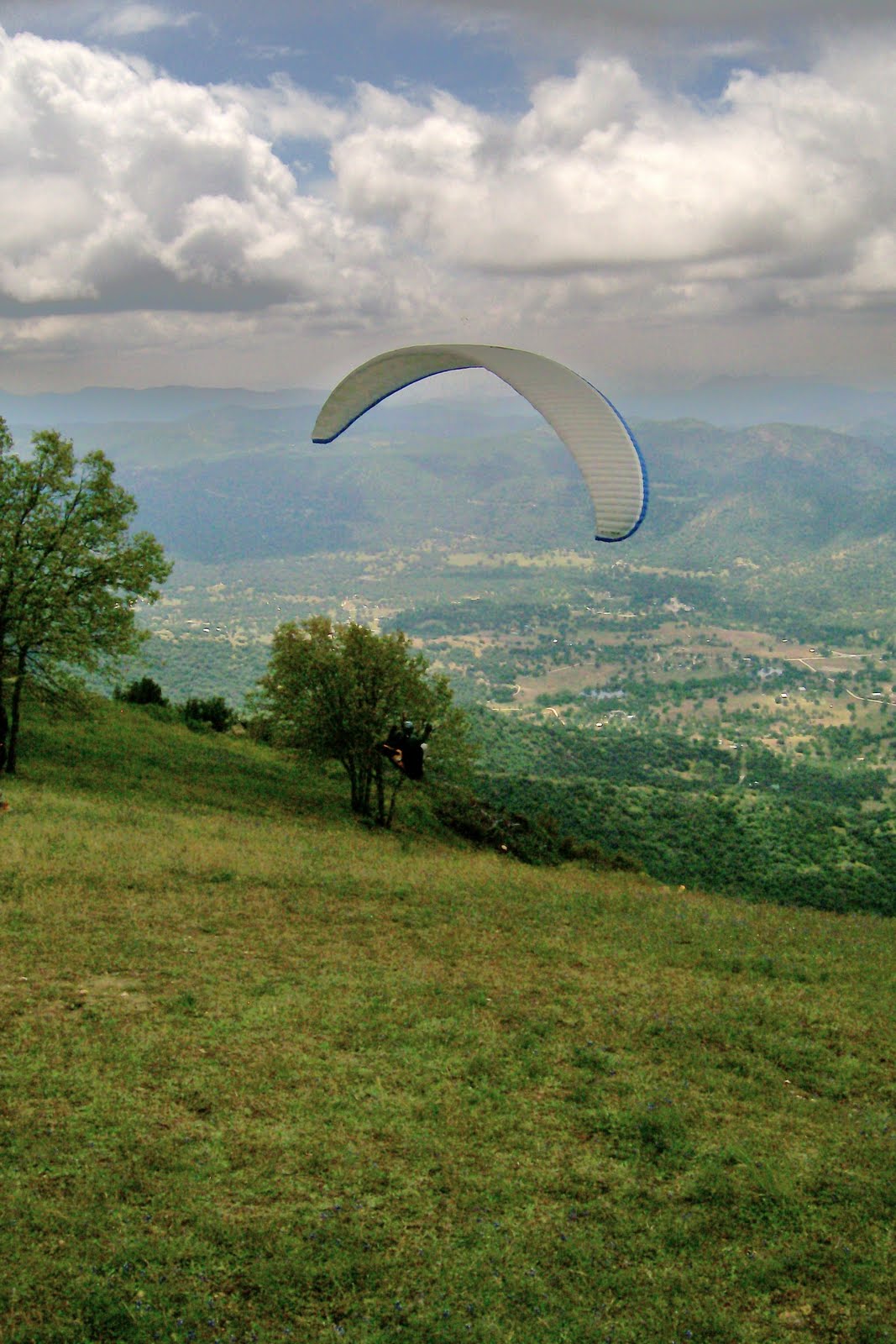
Saturday the troops all assembled at Dan's at 9:30 and we headed up the hill at 10:30. The conditions were forecast to be good with lift to 6-7000' and a NW wind in the valley. A task was called from launch to hill 49917 and back, then over Big Cat - and Bald, then a leg to Orosi in the flats for a total of 25 miles.

I had a good high start and barred it all the way to Hill 49917 the lift there was sporadic, but I soon found a thermal pulsing off the hill. I climbed high enough to get back to launch and caught some lift with the lead gaggle. We all headed down to Big Cat and then hit the 4km cylinder around Bald Mtn.
A few wings turned directly to Ruth Hill and were struggling low in the shade, so I was looking for alternatives. To my right (the wrong way to Orosi) was in sunlight and I thought about heading there to poach a bubble off the low hills. At that same moment, I noticed Josh coming across low to the same area. He began to circle low in weak lift and I came in on top of him. The lift was weak but soon bloomed and we climbed together to over 6000' which made it possible to pick our way past the shade at Ruth Hill and start a relatively straight forward flight to Orosi. The clouds were working well and lift was often 500-600'/min. Josh pulled ahead when it was obvious that the flight was going to be easy and beat me to goal by 3 minutes. Fredric and Steve made it to goal about 30 minutes later and Hoop made a great effort, landing 1km from goal.
Lesson reaffirmed: Don't follow others into conditions that are obviously NOT working. Look for viable options and try to capitalize on the opportunities they present.

.jpg)
I feel very good about the weekend for two reasons. Firstly; My indecision regarding how I was going to compete this season (and in future seasons) was resolved, as I sold my Boom 5 on Friday and ordered a new Gradient Avax XC3 on Thursday. I'm flying serial class for the foreseeable future.
Second; I left the Boom in the bag and flew my three-yr-old Avax XC2 well this weekend and placed 2nd to Josh in both tasks. I really feel like some of the effort I've put into studying the game is paying off.
The league has really flourished due to Jug's efforts. Introducing the Mentoring program and reevaluating the goals of the league to promote the participation and education of newer pilots has revitalized the league. It's going to be a great season.
Results are HERE.
and more photos can be viewed HERE
Tim
Wednesday, May 5, 2010
Scary Moments and an Appeal
Every one of us has done it. Had something happen that makes us look around and think. "WOW, that could have been really bad!" For many it happened in a car. For most who read this blog - it happened while hanging in a harness and realizing exacly how fast 32'/sec.2 really is.
It might have been a shoddy approach to a sketchy, too small field; or it might have been a collapse right after a mis-timed launch that threatened to swing us viciously into the hill - These are moments we will permanently burn into our flying brain - so that the fact we dodged the bullet - this time - isn't lost on us. That we are able to fly another day makes us more appreciative of that fact, and more careful to protect that ability. We've all gotten away with some scary moments. Every once in a while we don't.
At my first paragliding XC competition, The Rat Race, I met a great guy named Jeff Huey. He was a top-10 pilot who was a bit older than many of his contemporaries and a respected pilot. He's generous with his advice and as humble as they come. He made an impression on me because I had definitely been bitten by the bug and he had attained a level of competence and respect that I aspired to - Shortly after the comp, it happened. I heard about his accident through the grapevine. He had crashed in Mexico while practicing before a comp. He had broken his back and had profound loss of mobility. That was 4 years ago.
Jeff has been through a lot since then. If a man shows his true character while enduring adversity, his character would fill a stadium. While in pain and confined by his injuries, he still was the great personality and sound advisor at many events. Well, it's not over for Jeff and he could use some support from the community. I hope you'll help this friend in need. You can be an encouragement just by writing. Recently one of his fellow "TeamLoser" compadres wrote the following:-
Tim
It might have been a shoddy approach to a sketchy, too small field; or it might have been a collapse right after a mis-timed launch that threatened to swing us viciously into the hill - These are moments we will permanently burn into our flying brain - so that the fact we dodged the bullet - this time - isn't lost on us. That we are able to fly another day makes us more appreciative of that fact, and more careful to protect that ability. We've all gotten away with some scary moments. Every once in a while we don't.
At my first paragliding XC competition, The Rat Race, I met a great guy named Jeff Huey. He was a top-10 pilot who was a bit older than many of his contemporaries and a respected pilot. He's generous with his advice and as humble as they come. He made an impression on me because I had definitely been bitten by the bug and he had attained a level of competence and respect that I aspired to - Shortly after the comp, it happened. I heard about his accident through the grapevine. He had crashed in Mexico while practicing before a comp. He had broken his back and had profound loss of mobility. That was 4 years ago.
Jeff has been through a lot since then. If a man shows his true character while enduring adversity, his character would fill a stadium. While in pain and confined by his injuries, he still was the great personality and sound advisor at many events. Well, it's not over for Jeff and he could use some support from the community. I hope you'll help this friend in need. You can be an encouragement just by writing. Recently one of his fellow "TeamLoser" compadres wrote the following:-
As many are aware, Jeff Huey is paralyzed below his chest as the result of a paragliding accident he suffered in Mexico four years ago. The injury was a broken neck at C7 which required the removal of the broken vertebrae and hardware installed across that area. Jeff’s recovery after his accident has been inspiring! Until recently he has been driving himself to his rehab sessions at the pool, working around the yard and performing all the other tasks we all face daily.Heal well Jeff -
Unfortunately there has been a series of medical complications and setbacks which required Jeff to endure an extended hospital stay with a specialist in Seattle, WA, far from his home in Bend, OR.
The recent problems began with high muscle tone on the left side of Jeff’s body tightening and pulling the ball of his femur out of the socket, which would then go back in place when his body would relax. The socket eventually wore out, creating significant pain where the ball of his femur was wearing through the socket. Jeff can’t necessarily feel pain below his chest at the site of an injury, but his body does and the effects of the pain make his daily routines extremely difficult, or even impossible.
In May 2009, Jeff was injected with a shot to deaden some of his leg muscles to prevent them from pulling the ball from the socket. Unfortunately this didn’t solve the problem, and so in October he underwent surgery to have the ball of his femur removed: the first half of a hip replacement which can be completed if he regains movement in his legs.
But after this surgery severe pain was still present. Images taken of his spine revealed that two more of his vertebrae, T9 and T10, had disintegrated and a third was wearing away. This is right at the point in his middle back where he can move his torso, which created a kind of unsupported hinge which ground away the bones. In January Jeff found a surgeon in Seattle to fuse the vertebrae from T5 to L1. The surgery went well and after a short stay in the hospital he returned to his house in Bend and was doing well with his recovery.
After a short time, however, the recovery took a bad turn and Jeff was again feeling the effects of severe pain. He endured this deteriorating condition for several days before being urged to have things checked out at the local hospital. The following day a new CT scan showed that several of the screws had been pulled from the vertebrae they were anchored to, causing significant damage to those vertebrae. It is likely that the screws pulled out during a transfer from his wheelchair to another surface where he slipped to the floor, but the cause remains unsure. The next day Jeff was flown Air Life to Seattle to his surgeon and she fused C6 to L1 to span the new injury. Two days into the recovery, while heavily sedated, Jeff fell out of the hospital bed. Apparently the side bar was left down. When found he was in respiratory distress because of fluid on the lungs, requiring yet another trip to the ICU, where tubes were put in to drain the fluid. The fluid turned out to be spinal fluid, so Jeff was fitted with tubing into his spinal column to relieve the pressure. The procedure was successful and Jeff was transported back to Bend to a skilled nursing facility where his recovery may take up to twelve weeks.
Through it all Jeff remains in good spirit and continues to amaze with his expanding medical knowledge and humor in the face of it all. Jeff has excellent medical coverage, but even so it doesn’t cover all the expenses associated with something like this. While his hospital services were covered his coverage for care at the nursing facility has run out and he will be required to pay $6,000 for the final four weeks of care. He will also have to pay $5,000 out of pocket for his ambulance transport from Seattle back to Bend. In light of his situation we have set up a pay pal account where anyone who feels like helping out can do so.
Pay Pal users can send donations to "jeffh22037 (at) yahoo.com"
Also Jeff is registered on Facebook if you would like to send him some encouragement!
Thanks.
TeamLoser.
Tim
Monday, April 26, 2010
5 minutes of fun - Cuesta Today April 2010
60 minutes of driving, 35 minutes of hiking, and 90 minutes of parawaiting - For 6 minutes of flying?
It's that good ;-)
Tim
Cuesta April 2010 from Tim O'Neill on Vimeo.
Saturday, April 24, 2010
Flying in Paraglider Competitions - A Primer, Part 6
This is the sixth installment in the series,
"Flying Paragliding Competitions - A Primer"
"Flying Paragliding Competitions - A Primer"
Please send me any comments and/or requests for info
that you would like to see included.
Variationsthat you would like to see included.
Some competitions utilize variations of the formats mentioned so far. I’ll mention a few here so that they are not a complete surprise when they are utilized. If any of these options are exercised you can expect some explanation from the CD to answer questions at the Pilot Meeting.
Alternate Tasks – Occasionally, when weather conditions are in transition, the Task Committee will build an “A” task and a “B” task. Each task fits weather conditions that may develop. The Task Committee will call the appropriate task at a later pilot meeting when the weather forecast is more developed. A good strategy is to write down each task with all details, then program both into your GPS. When the task is called, you can make the appropriate route a competition route, and/or activate that route.
Multiple Start Gates – When the Task Committee considers it necessary, a start with multiple start times, or gates, will be specified. A “first” gate at 1 PM may be specified with 15 minute intervals between gates, and the last start at 2:15 – for example. What this means to you is that you can choose to start the task any time after 1 PM. Your elapsed time for the task will be computed from the time of the last start gate time that expired prior to you leaving the start cylinder. This format can provide some strategic opportunities including: Choosing the gaggle you’d like to fly with; Flying out on course, and then returning for a later start gate (if conditions become stronger for example) etc.
Ground Starts – At large launch sites this option can be used and is quite a sight. At the “start” time all participants launch and begin the task. Elapsed time begins at the start-time. These are generally not seen in the USA.
Open Distance – The XC Open series uses this format. Instead of a task committee setting your waypoints and goal, you choose the turn-points. There is no goal other than the horizon. Flying these tasks can be less stressful, but also has less ‘mano-a-mano’ feel.
Class Racing – Most competitions have an “OPEN” class and a “SERIAL” class. Some also include a “SPORT” class. Serial Class includes EN-D wings and Sport Class includes EN-C, B, or A. Usually all pilots, in all classes, will fly the same task. Scoring is not handicapped or given premium based on class.
Handicapped Racing – Some competitions use a handicapped score to allow pilots of low experience and flying low performance wings to score a ‘value plus’ score. This type of scoring is sometimes used in Open Distance type of tasks and is useful in Team scoring.
Additional Equipment
Other than the equipment mentioned previously, I carry the following:
SPOT – The SPOT unit is a valuable piece of kit when flying XC. Unlike cell-phones, it uses satellite phone technology to make a graduated request for aid. I think it is cheap insurance.
www.findmespot.com
Tree Kit - I carry a home-made kit similar to the kit in this article from www.towmeup.com.
Survival Kit – I carry a kit with the items listed in my article.
Water – I carry a 2 liter water bladder in my harness and 1 or 2 additional liters in my pack.
Condom Catheter - Believe it or not, this is an important item. I am able to drink freely and allow proper hydration while flying a long task. Once you’ve used the CC, you will be a believer also. Girls, I’ve heard some use adult diapers, but I have no first hand info -
Oxygen – Many competitions are held in mountain sites where it is not uncommon to get over 15,000’. A pilot’s performance is noticeably affected when at high altitude for any length of time. Oxygen also helps the pilot stay warm when properly oxygenated.
4. Putting it All Together
Your task is to tie this all together. The difference between Cross Country flying and flying Cross Country Tasks is similar to the difference between waterskiing around the lake for fun and skiing a slalom course at a prescribed speed. Flying an XC task requires specific skills, preparation, planning, and strategy. The best way to build the skills and learn the strategies required to fly in comps, is to fly comps. It is a specialized skill-set that, when you achieve a level of competence, leads to understanding and competence that carries over into your non-comp flying.
Safety
The trickiest time, in your XC competition ‘career,’ will be your first 3-4 competitions. Your experience is lacking, while your enthusiasm and competitive drive are high. Many pilots are of the opinion that flying comps is dangerous. I disagree. Flying beyond your experience is dangerous. Flying wings that you are unable to fly competently is foolhardy. Competition pilots are some of the most experienced and safety-minded pilots you will meet. Make a concerted effort to be a safe and mature competitor, and your longevity will guarantee you a degree of success. You can begin by choosing to fly a wing that you are comfortable on. Get experience flying in thermal conditions and launching in variable winds. Practice your wing control so you are comfortable on launch. Each landing should be planned and controlled. When LZs are scarce, don’t “put yourself in a corner” where there are no good options. In short – Use your head. Remember that this is not your livelihood. It is simply, an ‘optional’ activity.
Expectations
When you begin to fly XC comps your primary goal should be to fly each task as safely and successfully as possible. Don’t try to race. Make every attempt to fly with a gaggle to cover the miles and make it to goal. Making goal equates to success. When you land short of goal you should try to learn from the experience. How did others get through that area? Could you have increased your chances? I’ve found that writing up a debrief of each flight has future value when reviewing flights. Expectations to learn are good since, even if you land short of goal, you will have valuable lessons to learn.
Strategy
Be a student of the game. You will soon understand that a paraglider competition task is like a road-bike race where cooperation and courtesy are important to your success. The real race doesn’t begin until that last thermal when everyone in the lead gaggle is computing their glide to goal. The pilot with the fastest wing, with the best glide, and the most accurate final glide computation (not to mention largest cojones), wins. Your strategy is different. Your goal is to fly with a gaggle of similar performance pilots and wings to work your way around the course to goal. As your skill improves you will find that the company you keep will be of better quality.
Camaraderie
There are many learning opportunities during the competitions. If Mentoring is offered, take the time to ask questions and discuss mistakes with your Mentor. Take the opportunity to talk with the successful pilots when it presents itself. Be sensitive to timing and don’t be a distraction when the pilots are setting up for a task. Beer seems to be a good trade for expertise. Some pilots are more conversational than others, but we all know that new pilots have questions and we are happy to work with them.
Success
Each of us has our own goals. This sport has so many layers of challenge that ‘mastering’ XC competitions is quite a lofty goal. Even pilots who have flown competitively for decades have bad days and make the occasional mistake. The trick is to make less mistakes than you did last flight, each time you fly. When you have your gear set-up correctly, when you know how to use your electronics to your best advantage, and when your flying skills and strategy are optimum for the day, you will fly a ‘good task’ to goal – the feeling of accomplishment is very rewarding. Your rank is a secondary measurement to that of the joy you feel. Hang-on, because NOW you are hooked.
Tim
Tuesday, April 20, 2010
Saturday, April 17, 2010
Dunlap Trip with SLOSA Friends
Click on photos to view the images at full size.

L to R, Dave, Bruce, Tim, Patrick, Mike
with a hazy launch in the backgroundThis week 4 of us from the San Luis Obispo area headed to Dunlap to fly. We arrived Wed., around noon, and set up camp at the Dunlap Flight Park (Dan's Place). Greg made us feel welcome and offered to drive us to launch. The weather was classic Spring cu's with cloudbase around 4500-5000'.


Thursday we headed to another site to fly with Tom M. It's a site with limited access, so let's just call it no-name. The launch was a very intimidating granite dome that tailed off into a 1000' vertical face. There were two primary spots to launch. One had more space to turn and run at the cliff - but it had a 5' by 5'tall tree to negotiate at the lip. I chose a rather tighter spot with about 6' of granite between me and the cliff while pulling up. I launched first and the pull up and turn went well, I had good pressure in the wing and took two steps into the void. I had an immediate good climb to the low cloudbase (about 400' over launch) but got flushed in a down cycle and, after a 15 minute scratchfest, landed in a tight meadow at the base of the hill. Dave and Patrick and Tom all launched shortly thereafter, into a nice sunny period and made it Northwest along the ridge, and landed in big fields out there. It was an enjoyable day and fun to explore a new launch site.

In all it was a great three days. No epic flights, but nice company, enjoyable times, and many safe landings.
Tailwinds,
Tim
Monday, April 12, 2010
Flying in Paraglider Competitions - A Primer, Part 5
4. Flying the Task
This is the fifth installment in the series,
"Flying Paragliding Competitions - A Primer"
"Flying Paragliding Competitions - A Primer"
Please send me any comments and/or requests for info
that you would like to see included.
that you would like to see included.
Part one may be read HERE
The scope of this article is that of supplying information for use by new pilots in competition flying. For that reason, I will discuss flying tasks as a new pilot on a lower/mid performance wing. The strategies one uses when beginning are different than when the pilot has the skills and wing performance to stay in contact with the lead gaggle. For now, your goal is to make as few mistakes as possible during the task.
Philosophy and Strategy
You are here, not to win the competition, but to Learn and have Fun. You can maximize your learning opportunities, score, and your fun, by make it to goal. I caution you to not let your competitive juices get the better of you. While getting carried away in a weekend soccer game can leave you sore and bruised, making decisions that put you in harm’s way during a PG event can have much more serious consequences. Use your head so you may fly another day.
It is a valid strategy, at this point in your flying, to be a follower and fly with the gaggles around the course. Flying with friends increases your odds for making it along the course. Racing along at your own pace, alone, is just about guaranteed to put you on the dirt, or in holes that slow your speed considerably.
Planning the Task
Once the task has been programmed into your GPS and you have a moment to look at your map, take a moment to plan your flight. It’s a given that you will need some key climbs during the task. You can depend on luck, others showing you the lift sources, or you do your own strategizing. As an example, if the top-of-lift for the day is planned to be 2,500 meters, and the ‘lift-band’ is roughly 2000 meters deep (In other words, below 500 meters you would be in danger of bombing out due to lift being broken or weak below 500meters) then you will have transitions (at a glide ratio of 6:1) of no more than (2000 meters X 6) or 12 Kilometers. To fly a 50 Km. task you will need at least 5 full climbs, or more partial climbs to make it to goal. Plan these climbs by looking for lift sources, spaced accordingly along your route. Keep in mind the forecast winds for the day. You should also look for potential ‘crux points’ along the route so you can plan to attack this portion of the task with other pilots to increase your odds of completing the transition successfully.
When to Launch
I’ve already discussed launch organization a bit and you shouldn’t underestimate the importance of your decision regarding launch timing. Generally, I recommend launching shortly after the wind techs have demonstrated that there is sufficient lift to stay in the air. It works out well to launch 30 to 45 minutes before the start time. If it is obvious that you will have traffic in the queue and/or the weather conditions are variable, you may want to be suited up and ready to launch early, so you can take advantage of any launchable window. I’ve seen very experienced pilots loose a task before they even launched, by delaying their launch for one reason or another, only to have the wind turn and make the launch impossible or excruciatingly slow. Remember that you will need to consider your rank in the ordered launch to decide whether to wait or use the open launch period. If in doubt, get in the air at your earliest opportunity.
The Pre-Start
Once in the air, I do a quick inventory to make sure my instruments are all working properly, speed system is working correctly, water source is OK, and that the condom catheter is un-kinked. Spend time exploring the immediate area around the start cylinder for lift triggers and note the wind direction and speed. All this information is data that is useful in planning your start. At this time you also want to get to the top of lift and stay there. The best pilots have a knack of getting high and staying there, prior to the start. 10-15 minutes before the start you want to get serious about putting yourself in the optimum position for your start.
The Start
Ideally your start should take place at the optimum edge of the start cylinder, just after the start time expires. The optimum edge is determined primarily by the wind. You want to place yourself upwind of the course line if possible. As the Start-time approaches, you need to remember one very important thing – It is better to be late across the line than to cross early. If you do cross the start cylinder early, or if there is ANY doubt, do a quick turn back and re-cross the line. You will receive no points for the day if you blow the start and continue on course.

By noting your groundspeed, as you approach the start cylinder, you can use the Start Planning Chart in the appendix to help you judge your time to cross.
Back to the start for a moment: If you find yourself low and/or out of position for the start, don’t get frustrated and desperate. We’ve all had bad starts. Take the time necessary to get up and make a reasonable start. Remember that you are not ‘ahead’ if you are the lowest glider in the valley – you’re just LOW. Take your time and don’t compound error.
Flying the Task
Once you are on course, you are flying with the intention of incrementally advancing along the route. Don’t let the specter of the distance intimidate you. Just keep on working your way from climb to climb. On transitions you should spread out so that you and your gaggle-mates can cover a large search area for lift. When you see someone turn, wait a bit and verify they are going up, before moving to them. While you are looking at the task in short increments, it is also important to keep the “big picture” in mind also. By that I mean that a good pilot is looking down the course, at wings preceding her, and also anticipating the conditions as they change with time.
Pace is very important to successful execution of the flight. Some stretches can be flown fast when the lift is strong and abundant. Other transitions will require a deft touch and the use of every scrap of lift. Sensing this change in pace is very important in longer tasks that fly through many micro-climates and into the later portions of the day. One way to learn this pacing is to work with more experienced pilots. When they slow down, you should do so also.
Don’t give up when things look bleak. As long as you keep yourself in the air, you have a chance to get back up. Don’t wait until you are desperately low before you begin to work every foot out of the available lift. Remember that the bubble that is teasing you may turn into a fully developed thermal core in 100 meters. Always work towards getting up. Never go on a “Death-Glide” when you have the option of gliding to a lift source. It can even make sense to back-track to a lift source, if the best odds for survival are located there.
When you are a thermal or two from goal you should be looking at your final glide calculation. The big-boys are going to work this out down to the millimeter and then play chicken with each other until one blinks & starts his final glide on full speed-bar. You are going to be a bit more conservative and make it to goal with some altitude so you can bask in your glory before landing ;-) Keep your distance to goal in mind, even prior to the last turnpoint, so you can have a good idea when to begin your final glide. You should have a good idea of your L/D Over the Ground, when heading in the direction of goal, so you can come up with a number (altitude or L/D req’d to Goal) where is will be possible to begin your final glide. Don’t get in a hurry and make up an optimistic number – I’ve landed 1K short of goal after a 3 hour flight – it’s not fun. Give yourself a guaranteed final glide & relax as you head into goal – it feels marvelous!
Most Goal Lines are a cylinder around a waypoint (like any other turnpoint) however many will have goal as a 400meter cylinder with a 1Km End of Speed Section (ESS). What this means to you is that when you make goal, your speed will be the average speed between the start and the ESS point. You can stop ‘racing’ at 1K – You DO, however, need to cross the 400m cylinder to get your full points (speed, leading, etc.) Don’t forget to proceed all the way to goal, and don’t race on bar if it looks doubtful that you will make it all the way to the 400m cylinder.
Part 6 is HERE
More to come -
Thursday, April 1, 2010
Flying in Paraglider Competitions - A Primer, Part 4
This is the fourth installment in the series,
"Flying Paragliding Competitions - A Primer"
"Flying Paragliding Competitions - A Primer"
Please send me any comments and/or requests for info
that you would like to see included.
that you would like to see included.
Part one may be read HERE
The primary differences, between Large Competitions and those held regionally, are those of scale. The flying venues are sites that can accommodate many pilots at launch, and any gathering of pilots will see over 100 in the room rather than the 20-30 at League events. For this reason you will find more organization to the administrative side of larger comps. At the top of the pyramid is the Competition Director (CD). The CD has the responsibility to deal with any issues that come up during the competition. To take some of the load off the CD, committees are formed with committee members chosen from the pilot group. Usually the committees are the Task committee, Protest committee, and Safety committee. Each of these committees consist of appointed pilots who have XC experience in the area and the respect of their fellow pilots.
The Task committee: The goal of the Task committee is to use the day’s forecast to produce a task that is challenging, possible by a percentage of the field, and safe.
The Protest committee: Fields protests regarding all issues regarding procedures, scoring, penalties, and misconduct. Protests are relatively rare and not considered by the committee unless a timely, written protest is filed and a protest fee (determined prior to the first task) is paid. The fee is only returned if the protest is ruled in favor of the protestor.
The Safety committee: Input from members of the Safety committee is considered by the CD in making decisions regarding launch safety, safety on course, and important decisions regarding flying the task vs. cancelling or stopping the task.
Don’t be intimidated by the size of the field or the quality of the pilots and their exotic wings. The higher the quality of the field, the more learning opportunities there will be for you.
For you, the differences will be seen in the following instances:
- The websites for larger comps are less oriented towards the ‘new’ pilot. If you desire information about the flying venue, you will have to do the exploration using Google Earth or similar map program.
- The waypoint files will be loaded into your GPS units at the competition briefing by the scorer. It will also include your pilot number as a unique waypoint in the unit. You can make the scorer’s job easier by clearing all routes and waypoints from your instruments prior to arrival at the scorer’s table. If you have an ‘exotic’ GPS unit, I would recommend that you bring the cable for the unit with you, in case the scorer does not have a cable for your unit. If it is new and exotic, you might send an email to the Competition Director asking if your instrument will be supported.
- It is essential that your NAME and PILOT NUMBER are visible on the flight instrument case.
- The Competition Director will hold a mandatory Pilot Meeting the evening before the competition begins. Bring your Instruments and notepad to this meeting. You will be checked in and given some type of bag-tag or card with your pilot #. It will also include phone #s for the competition staff and emergency contacts.
- Transportation to the launch site is usually provided and the cost is included in the entrance fee.
- Retrieves are usually included in the entrance fee.
- All of the caveats relating to “Good Form” still apply.
- As a new guy though, try to find a helpful pilot with some experience to answer your questions. In the US, a great first ‘BIG’ competition is the “Rat Race” put on by the Haley’s in Ruch, Oregon. They have a well developed Mentor Program that is designed to help novice XC competition pilots participate safely.
- Usually a big comp. will have a Launch Window based upon your standing in the competition. For example; The meet director may announce that Launch Opens at 12:30PM with Ranked Launch beginning at 1PM. For you this means that you will have the opportunity to launch early, without restriction, until 1PM. After 1PM your ranking in the comp will allow all pilots with a higher ranked score to pass you in the queue. The possibility of being stuck in the queue is quite high for a low ranked pilot, after Ranked Launch begins.
- To ensure that the meet director knows who is flying, you are required to check in when ready to launch. This safety precaution is imperative to guarantee that all pilots are accounted for at the end of the day.
- It is absolutely essential that you check in at the end of your day to notify the Competition Director that you are down and safe. Even if you bomb-out and end your day in the LZ, 20 minutes before the start of the race, you MUST check in and submit your track at the end of the day. There is always somebody who forgets this and causes grief for the CD - Don't be this guy.
- Some competitions, because the logistics allow for easy transport from the LZ to launch, will allow a “RELAUNCH”. This option may have specific times and rules associated with it. Have a plan if you are in danger of landing in the LZ. Sometimes it is advantageous to land rather than miss the relaunch shuttle because you tried to pull off a low save in vain.
Wind Tech
Large Competitions often offer the option of serving as a ‘Wind Tech’ to pilots who are unsure whether they want to participate in the competition but would like to fly during the event. If you are tempted to participate at that level, it is a good way to get a taste of the event. There are certainly positive and negative aspects to flying as a Wind Tech, depending on your goals –
Positive Aspects of being a Wind Tech–
- You are not required to enter the competition to act as a wind tech. This saves you the cost of entry and is an option if you can only participate in a few days of the scheduled competition.
- You will see the workings of the competition and how your fellow pilots prepare.
- You will have the chance to fly with the competition pilots prior to the start of the task.
- Your flying will not have the perceived pressure of competition, but you will gain some experience just by attending and flying the event site.
- You may have the option of flying on course (if allowed by the Competition Director)
Negative Aspects of being a Wind Tech –
- You will not be scored and, generally, not allowed to fly the course. You are looking at the event from the outside in. This may have you gleaning less experiential value than if you were to actually fly the competition.
- Your flying is “at the pleasure” Competition Director.
- You will be told when to launch. It will be timed well before Launch Opens and timed so that the air can be sampled for start planning and safety considerations.
- You may not qualify for a free retrieve.
Good Form as a Wind Tech
Remember that your flying is allowed so you can be of service to the competition by demonstrating and reporting the type of day it is. Both the competition pilots and Competition Director will be using your flight, and those of other Wind Techs, to gauge the wind, and the quality of the day.
Remember that a request by CD to launch is just that – a request. YOU must determine the safety of your launch. Consider the conditions and your experience when deciding to fly. I’ve seen wind techs launch in conditions that many of the comp pilots were uncomfortable with. Safety is an acceptable reason to refuse a request to launch from the CD.
Remember that the participants all paid an entrance fee to fly in the event. Fly in a way that is helpful and uncompetitive. You should always consider the comp pilots when they are looking for seats in the van to launch, in your thermal, or jockeying for position for the start. I’d say that 5 to 10 minutes before the start a wind tech should not hinder any other pilots. Don’t expect to fly the task and don’t turn in your GPS for scoring.
More to come -
Part 5 is HERE
Tim
Subscribe to:
Posts (Atom)